Violent Protest Breaks Out in Pak Over Demand of Separate ‘Sindhu Desh’
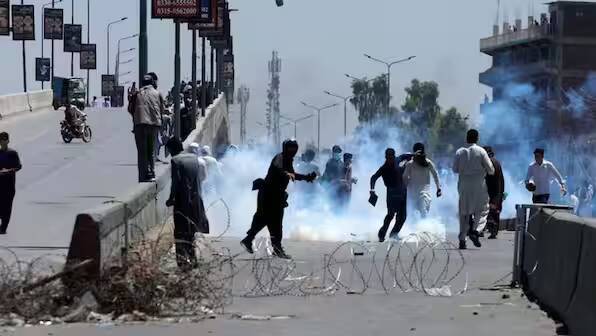
The city of Karachi in Pakistan witnessed a violent protest on a recent day, as a large gathering of Sindhis demanded a separate homeland, which they referred to as ‘Sindhu Desh’. The protest, which was organized under the banner of Jiye Sindh Muttahida Mahaz (JSSM), quickly turned violent as stone pelting and clashes with police were reported. The protesters, who were raising slogans of ‘Azadi’ (freedom) and ‘Pakistan Murdabad’ (death to Pakistan), were redirected by the authorities, which allegedly sparked the violence.
According to reports, the protesters were initially peaceful, but the situation took a turn for the worse when the authorities attempted to change the route of the rally. This move was seen as an attempt to suppress the voices of the Sindhi people, who have been demanding greater autonomy and rights for their province. The redirected path led to a confrontation between the protesters and the police, resulting in stone pelting and clashes.
The JSSM, which is a prominent Sindhi nationalist organization, has been at the forefront of the movement for a separate ‘Sindhu Desh’. The organization has been advocating for the rights of the Sindhi people, who they claim have been marginalized and oppressed by the Pakistani government. The demand for a separate homeland is not a new one, but it has gained significant momentum in recent years, with many Sindhis feeling that their province is not being represented fairly in the Pakistani government.
The protests in Karachi are a manifestation of the deep-seated frustrations and grievances of the Sindhi people. For decades, Sindh has been one of the most economically and culturally rich provinces in Pakistan, but it has also been plagued by poverty, corruption, and lack of development. The Sindhi people feel that their resources are being exploited by the federal government, and that they are not being given a fair share of the power and decision-making.
The demand for a separate ‘Sindhu Desh’ is also driven by a sense of cultural and linguistic identity. The Sindhi language and culture are distinct from those of other provinces in Pakistan, and many Sindhis feel that their unique identity is being eroded by the dominant Punjabi culture. The JSSM and other Sindhi nationalist organizations have been advocating for the preservation and promotion of Sindhi language and culture, and for greater autonomy for the province.
The situation in Sindh is not isolated, as similar movements for autonomy and independence are emerging in other provinces of Pakistan. The Balochistan province, which is located in the southwest of Pakistan, has been witnessing a separatist movement for several years. The Baloch people have been demanding independence from Pakistan, citing historical and cultural reasons, as well as grievances over the exploitation of their natural resources.
The Pakistani government has been responding to these movements with a mix of force and negotiation. While the government has been willing to engage in dialogue with some of the nationalist organizations, it has also been cracking down on others, using force to suppress the protests and arresting leaders and activists. The government’s approach has been criticized by human rights organizations, which argue that the use of force and repression only serves to fuel further unrest and militancy.
In the case of the Sindhi movement, the government’s response has been particularly heavy-handed. The authorities have been accused of using excessive force against the protesters, and of targeting Sindhi nationalist leaders and activists. The JSSM and other organizations have been banned, and their leaders have been arrested and detained.
Despite the government’s efforts to suppress the movement, the demand for a separate ‘Sindhu Desh’ is unlikely to go away. The Sindhi people are determined to assert their rights and to preserve their cultural and linguistic identity. The movement is likely to continue, with protests and demonstrations taking place across the province.
As the situation in Sindh continues to simmer, the Pakistani government would do well to engage in meaningful dialogue with the Sindhi nationalist organizations. The government needs to address the grievances of the Sindhi people, and to provide them with greater autonomy and representation. The use of force and repression is unlikely to resolve the issue, and may only serve to fuel further unrest and militancy.
In conclusion, the violent protest in Karachi is a symptom of a deeper problem, one that requires a comprehensive and nuanced solution. The Pakistani government needs to recognize the legitimate demands of the Sindhi people, and to engage in a constructive dialogue with their leaders. The demand for a separate ‘Sindhu Desh’ may not be feasible, but the government can certainly provide greater autonomy and representation to the province. By doing so, the government can help to address the grievances of the Sindhi people, and to prevent further unrest and violence.
About the Author