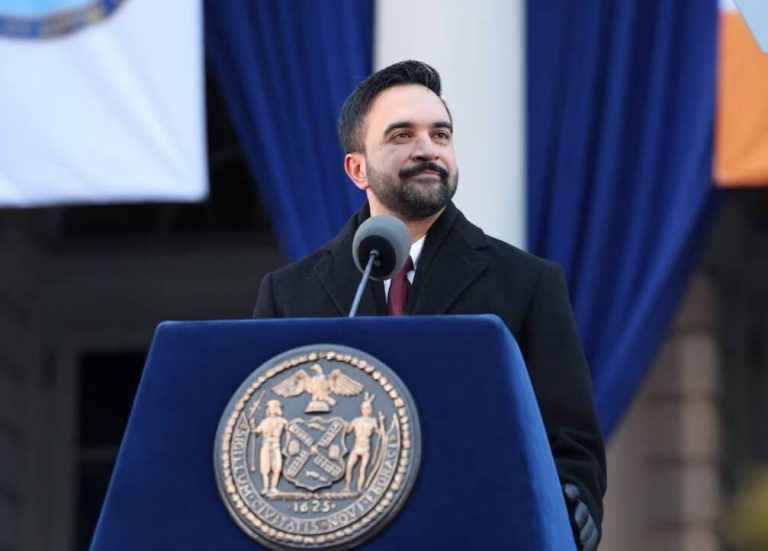
Showed true face: Israel accuses NYC Mayor Zohran of anti-semitism
In a shocking turn of events, Israel’s foreign ministry has accused New York City Mayor Zohran Mamdani of anti-semitism, just hours after he took office. The accusation comes as a result of Mayor Mamdani’s decision to scrap the IHRA definition of anti-semitism and lift restrictions on boycotting Israel. This move has sparked a heated debate, with Israel’s foreign ministry being quick to condemn the new mayor’s actions.
According to reports, Mayor Mamdani’s decision to reverse the previous administration’s policies on anti-semitism and Israel has been met with widespread criticism from the Israeli government. The foreign ministry released a statement to the media, saying, “On his very first day as New York City Mayor, Mamdani shows his true face: He scraps the IHRA definition of anti-semitism and lifts restrictions on boycotting Israel….It’s antisemitic gasoline on an open fire.” This strong statement sets the tone for what is likely to be a contentious relationship between the Israeli government and the new mayor of New York City.
The IHRA definition of anti-semitism, which was adopted by the previous administration, provides a framework for identifying and combating anti-semitic behavior. By scrapping this definition, Mayor Mamdani’s administration is essentially reversing course on the city’s approach to addressing anti-semitism. Additionally, the decision to lift restrictions on boycotting Israel is seen as a significant shift in policy, one that could have far-reaching implications for the city’s relationships with Jewish communities and organizations.
The Israeli government’s accusation of anti-semitism against Mayor Mamdani is a serious one, and it is likely to have significant repercussions. Anti-semitism is a sensitive and complex issue, and any perceived tolerance or promotion of it can have serious consequences. The fact that Mayor Mamdani’s administration has taken steps that are seen as hostile to the Jewish community and the state of Israel has raised concerns among many who value the strong relationship between New York City and Israel.
It is worth noting that Mayor Mamdani’s decision to scrap the IHRA definition of anti-semitism and lift restrictions on boycotting Israel may be seen as a reflection of his own personal views and values. As a newly elected official, Mayor Mamdani is likely to face significant scrutiny and criticism for his policies and decisions. The fact that he has chosen to take a stance on such a contentious issue so early in his term is likely to be seen as a sign of his commitment to his values, even if they are unpopular with some segments of the community.
The backlash against Mayor Mamdani’s decision has been swift and severe. Many Jewish organizations and community leaders have spoken out against the move, condemning it as a betrayal of the city’s commitment to combating anti-semitism. The Israeli government’s accusation of anti-semitism against Mayor Mamdani has also been echoed by many of these organizations, who see the decision as a clear example of anti-semitic sentiment.
Despite the controversy surrounding Mayor Mamdani’s decision, it is worth noting that the issue of anti-semitism is complex and multifaceted. While the IHRA definition of anti-semitism provides a useful framework for identifying and combating anti-semitic behavior, it is not without its critics. Some have argued that the definition is too broad, and that it can be used to silence legitimate criticism of Israel and its policies. Others have argued that the definition is too narrow, and that it fails to capture the full range of anti-semitic behaviors and attitudes.
Ultimately, the decision by Mayor Mamdani’s administration to scrap the IHRA definition of anti-semitism and lift restrictions on boycotting Israel is a complex and contentious issue. While it is likely to be seen as a betrayal by many in the Jewish community, it may also be seen as a necessary step towards addressing the complexities of anti-semitism and promoting a more nuanced understanding of the issue. As the situation continues to unfold, it will be important to watch how Mayor Mamdani’s administration responds to criticism and backlash, and how the city’s relationships with Jewish communities and organizations are affected.
In conclusion, the accusation of anti-semitism against Mayor Mamdani by Israel’s foreign ministry is a serious one, and it highlights the complexities and challenges of addressing anti-semitism in the modern world. As the city of New York navigates this contentious issue, it will be important to prioritize nuance, understanding, and respect for all communities and perspectives.
About the Author