India Resumes Ops at Dhaka Visa Centre after Closure amid Protests
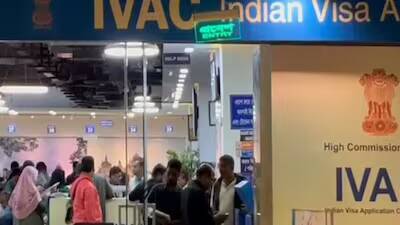
In a significant development, the Indian visa centre in Dhaka resumed operations on Thursday, a day after it was temporarily shut due to security concerns. The closure came after anti-India protesters marched towards the Indian High Commission in Dhaka, sparking concerns about the safety of the visa centre and its staff. The protests were reportedly triggered by a radical remark made by a Bangladeshi leader, Hasnat Abdullah, against India, which did not go down well with the Indian government.
The Ministry of External Affairs (MEA) summoned Bangladesh’s High Commissioner on Wednesday to express its strong protest against the remark, which was seen as an attempt to vitiate the bilateral relations between the two countries. The MEA’s swift action was aimed at conveying India’s concern and displeasure over the incident, and to ensure that such remarks are not made in the future.
The temporary closure of the visa centre was a precautionary measure taken by the Indian authorities to avoid any potential violence or unrest. The centre, which is responsible for processing visa applications for Bangladeshi citizens, is an important facility that facilitates people-to-people contact between the two countries. Its closure, even if temporary, could have caused inconvenience to many applicants who rely on the centre for their travel plans.
Fortunately, the situation was brought under control, and the visa centre resumed its operations on Thursday. The Indian High Commission in Dhaka has been working closely with the Bangladeshi authorities to ensure the safety and security of the visa centre and its staff. The resumption of operations at the centre is a welcome development, and it is expected to bring relief to many applicants who were affected by the temporary closure.
The incident, however, highlights the complexities and challenges of managing bilateral relations between two countries. The radical remark made by the Bangladeshi leader, Hasnat Abdullah, was seen as an attempt to whip up anti-India sentiments in Bangladesh. Such remarks can have far-reaching consequences, and can damage the goodwill and trust that exists between two countries.
India and Bangladesh have a long-standing relationship that is based on mutual respect, trust, and cooperation. The two countries have made significant progress in recent years in strengthening their bilateral ties, particularly in the areas of trade, commerce, and people-to-people contact. However, incidents like the one that occurred in Dhaka can pose a challenge to the relationship, and require careful handling and management.
The Indian government’s swift response to the incident, including the summoning of the Bangladeshi High Commissioner, demonstrates its commitment to protecting its interests and maintaining the dignity of the country. The MEA’s action was aimed at sending a strong message to Bangladesh that such remarks will not be tolerated, and that India expects its neighbours to respect its sovereignty and territorial integrity.
In the context of the current geopolitical situation, the incident assumes greater significance. The region is witnessing a complex web of alliances and rivalries, with multiple players vying for influence and power. In such a scenario, it is essential for countries like India and Bangladesh to maintain good relations, and to work together to address common challenges and threats.
The resumption of operations at the Indian visa centre in Dhaka is a positive development, and it is expected to facilitate the movement of people between the two countries. The centre plays a critical role in promoting people-to-people contact, which is essential for building trust and understanding between two countries. As the two countries move forward, it is essential to ensure that such incidents do not recur, and that the bilateral relationship continues to grow and strengthen.
In conclusion, the temporary closure of the Indian visa centre in Dhaka was a precautionary measure taken by the Indian authorities to avoid any potential violence or unrest. The resumption of operations at the centre is a welcome development, and it is expected to bring relief to many applicants who were affected by the temporary closure. The incident highlights the complexities and challenges of managing bilateral relations between two countries, and the need for careful handling and management of such situations. As India and Bangladesh move forward, it is essential to ensure that such incidents do not recur, and that the bilateral relationship continues to grow and strengthen.
About the Author