India Resumes Ops at Dhaka Visa Centre after Closure amid Protests
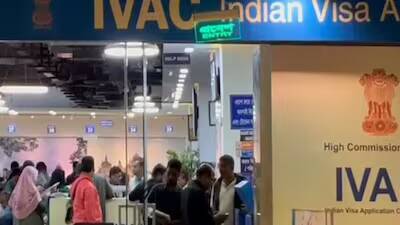
In a significant development, the Indian visa centre in Dhaka resumed operations on Thursday, just a day after it was temporarily shut down due to security concerns. The closure came in the wake of anti-India protests in the Bangladeshi capital, where protesters marched towards the Indian High Commission. The protests were sparked by a radical remark made by a Bangladeshi leader, Hasnat Abdullah, against India, which prompted the Indian Ministry of External Affairs (MEA) to summon the Bangladesh High Commissioner on Wednesday in protest.
The Indian visa centre in Dhaka is a crucial facility that caters to the visa requirements of Bangladeshi citizens seeking to travel to India. The centre is responsible for processing various types of visas, including tourist, business, and medical visas, among others. The temporary closure of the centre had caused inconvenience to many Bangladeshi nationals who were planning to travel to India for various purposes.
The protests in Dhaka were a result of a controversial statement made by Hasnat Abdullah, a Bangladeshi leader, against India. The remark was seen as an attempt to incite anti-India sentiment in Bangladesh, and it did not go down well with the Indian government. The MEA promptly summoned the Bangladesh High Commissioner to register India’s protest against the remark. The move was seen as a strong diplomatic response by India to the provocative statement.
The protests in Dhaka were organized by various groups, including student organizations and civil society groups. The protesters marched towards the Indian High Commission, shouting slogans and waving banners against India. The situation was tense, and the local authorities had to deploy security personnel to maintain law and order. The protests were largely peaceful, but the atmosphere was charged with anti-India sentiment.
The temporary closure of the Indian visa centre in Dhaka was a precautionary measure taken by the Indian authorities to ensure the safety and security of the centre’s staff and visitors. The centre is located in a sensitive area, and the Indian authorities did not want to take any chances in the wake of the protests. The closure was seen as a temporary measure, and the centre resumed operations on Thursday after the situation returned to normal.
The resumption of operations at the Indian visa centre in Dhaka is a welcome development, as it will facilitate the travel plans of Bangladeshi nationals who were affected by the temporary closure. The centre is expected to function normally, and visa applicants can now proceed with their applications without any disruptions.
The incident highlights the complexities of India-Bangladesh relations, which have been strained in recent times. The two countries have a long-standing relationship, and they cooperate on various issues, including trade, security, and culture. However, there are also differences between the two countries, particularly on issues like border management and water sharing.
The radical remark made by Hasnat Abdullah against India is a cause for concern, as it reflects a growing trend of anti-India sentiment in Bangladesh. The remark was seen as an attempt to whip up nationalist sentiment in Bangladesh, and it has the potential to damage India-Bangladesh relations. The Indian government has taken a strong stance against the remark, and it is expected to take up the issue with the Bangladeshi authorities.
In conclusion, the resumption of operations at the Indian visa centre in Dhaka is a positive development, as it will facilitate people-to-people contact between India and Bangladesh. However, the incident highlights the need for both countries to address the underlying issues that are straining their relations. The Indian government has taken a strong stance against the radical remark made by Hasnat Abdullah, and it is expected to engage with the Bangladeshi authorities to resolve the issue amicably.
The India-Bangladesh relationship is a vital one, and it is essential to nurture it through constructive dialogue and cooperation. The two countries have a shared history and culture, and they have cooperated on various issues in the past. However, there are also differences between the two countries, and it is essential to address these differences through diplomacy and dialogue.
As the situation returns to normal in Dhaka, it is hoped that the India-Bangladesh relationship will get back on track. The resumption of operations at the Indian visa centre is a welcome development, and it is expected to facilitate the travel plans of Bangladeshi nationals who were affected by the temporary closure. The incident is a reminder of the complexities of international relations, and it highlights the need for diplomacy and dialogue to resolve differences between nations.
About the Author