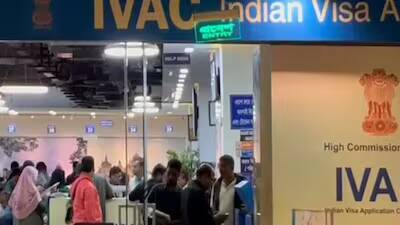
India Resumes Ops at Dhaka Visa Centre after Closure amid Protests
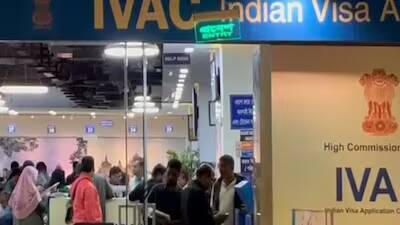
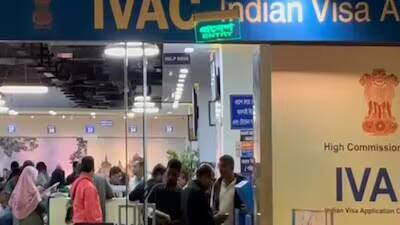
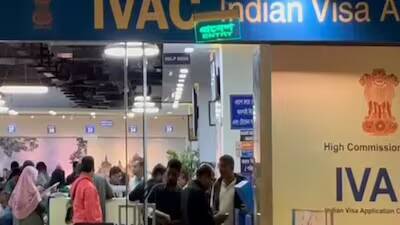
In a significant development, the Indian visa centre in Dhaka resumed operations on Thursday, a day after it was temporarily shut due to security concerns. The closure of the visa centre was a precautionary measure taken by the Indian authorities in response to anti-India protests that erupted in the Bangladeshi capital. The protests were sparked by a radical remark made by a Bangladeshi leader, Hasnat Abdullah, against India, which did not go down well with the Indian government.
On Wednesday, the Indian Ministry of External Affairs (MEA) summoned Bangladesh’s High Commissioner to express its strong protest against the remark made by Abdullah. The MEA’s swift response was aimed at conveying India’s concern and displeasure over the comment, which was seen as an attempt to vitiate the bilateral relations between the two countries. The Indian government’s decision to summon the Bangladeshi High Commissioner was a clear indication that it would not tolerate any kind of anti-India rhetoric or propaganda.
The protests in Dhaka were staged by a group of anti-India demonstrators who marched towards the Indian High Commission, posing a security threat to the diplomatic mission and its personnel. The Indian authorities, taking no chances, decided to temporarily shut down the visa centre as a precautionary measure to ensure the safety of its staff and applicants. The closure of the visa centre was a temporary measure, and the Indian government was keen to resume operations at the earliest.
The resumption of operations at the Dhaka visa centre on Thursday is a welcome development, as it will facilitate the travel of Bangladeshi nationals to India. The visa centre is an important facility that caters to the travel needs of thousands of Bangladeshi citizens who visit India every year for various purposes, including tourism, business, education, and medical treatment. The Indian government’s decision to reopen the visa centre is a reflection of its commitment to maintaining good relations with Bangladesh and ensuring that the bilateral ties between the two countries remain strong.
The incident, however, highlights the challenges that India faces in its neighborhood, particularly in Bangladesh, where anti-India sentiments often simmer just below the surface. The radical remark made by Hasnat Abdullah is a case in point, and it underscores the need for the Indian government to remain vigilant and proactive in responding to such situations. The MEA’s swift response in summoning the Bangladeshi High Commissioner was a timely move that helped to defuse the situation and prevent it from escalating further.
India and Bangladesh have a long-standing relationship that is rooted in history, culture, and geography. The two countries share a common border, and their bilateral ties are characterized by cooperation in areas such as trade, security, and connectivity. However, despite the strong foundations of the relationship, there are often challenges that arise, particularly in the form of anti-India protests and propaganda.
In recent years, India has taken several initiatives to strengthen its ties with Bangladesh, including the launch of several connectivity projects, such as the Bangladesh-India rail link and the India-Bangladesh inland waterways project. These initiatives have helped to boost trade and economic cooperation between the two countries and have facilitated the movement of people and goods across the border.
The Indian government’s decision to resume operations at the Dhaka visa centre is a positive development that will help to maintain the momentum of the bilateral relationship. It is essential for both countries to work together to address the challenges that arise and to ensure that the relationship remains strong and stable. The Indian government’s commitment to maintaining good relations with Bangladesh is evident from its decision to reopen the visa centre, and it is hoped that the Bangladeshi government will also take steps to prevent anti-India protests and propaganda.
In conclusion, the resumption of operations at the Dhaka visa centre is a welcome development that will facilitate the travel of Bangladeshi nationals to India. The incident highlights the challenges that India faces in its neighborhood, particularly in Bangladesh, and the need for the Indian government to remain vigilant and proactive in responding to such situations. The MEA’s swift response in summoning the Bangladeshi High Commissioner was a timely move that helped to defuse the situation, and it is hoped that the bilateral relationship between the two countries will remain strong and stable.
About the Author