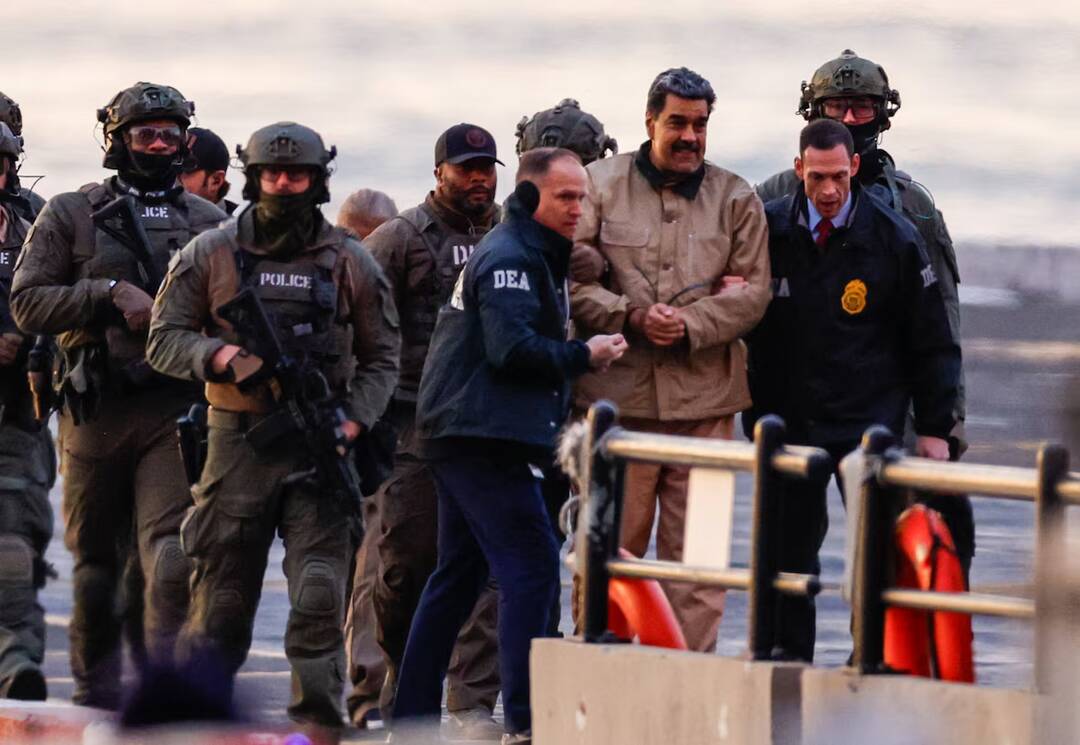
I’m still the President of Venezuela: Maduro as he pleads not guilty in US court
In a dramatic turn of events, Venezuelan President Nicolas Maduro appeared before a court in New York, where he was asked to identify himself. In a bold statement, Maduro replied in Spanish, “I am the President of Venezuela, and I was captured at my home.” The Venezuelan leader, who is facing narco-terrorism charges, pleaded not guilty and maintained his innocence, stating, “I am innocent, I am a decent man, I am still the President.”
The court appearance marked a significant development in the ongoing tensions between the United States and Venezuela. The US government has been a vocal critic of Maduro’s regime, accusing him of human rights abuses, corruption, and narcotics trafficking. The charges against Maduro are related to his alleged involvement in a conspiracy to traffic cocaine and other narcotics, which the US government claims has contributed to the country’s economic and social crisis.
Maduro’s appearance in court was a rare sight, as he has been a vocal critic of the US government and its policies towards Venezuela. The Venezuelan leader has accused the US of attempting to overthrow his government and has refused to recognize the opposition leader, Juan Guaido, as the legitimate president of the country.
As Maduro stood before the court, he maintained his defiance and refused to acknowledge the charges against him. He claimed that he was a victim of a US-led conspiracy to topple his government and that the charges against him were baseless. The Venezuelan leader also argued that he was still the legitimate president of Venezuela, despite the US government’s recognition of Guaido as the country’s interim leader.
The case against Maduro is complex and involves multiple countries and actors. The US government has accused Maduro of working with Colombian guerrilla groups and other organizations to traffic narcotics and launder money. The charges against him are based on evidence gathered by US law enforcement agencies, including the Drug Enforcement Administration (DEA) and the Federal Bureau of Investigation (FBI).
Maduro’s plea of not guilty is likely to be followed by a lengthy and contentious trial. The Venezuelan leader’s lawyers will argue that the charges against him are politically motivated and that the US government has no jurisdiction over him. The US government, on the other hand, will argue that Maduro’s actions have contributed to the suffering of the Venezuelan people and that he must be held accountable for his crimes.
The implications of Maduro’s court appearance are far-reaching and could have significant consequences for the future of Venezuela and the region. The US government’s recognition of Guaido as the interim leader of Venezuela has created a diplomatic crisis, with many countries in the region recognizing Maduro as the legitimate president. The court case against Maduro could further exacerbate tensions between the US and Venezuela, leading to increased instability and conflict in the region.
As the trial against Maduro proceeds, the international community will be watching closely to see how the case unfolds. The outcome of the trial could have significant implications for the future of Venezuela and the region, and could potentially lead to a resolution of the ongoing crisis. However, the complexities of the case and the political tensions involved make it unlikely that a resolution will be reached anytime soon.
In conclusion, the appearance of Venezuelan President Nicolas Maduro in a US court marks a significant development in the ongoing tensions between the US and Venezuela. Maduro’s plea of not guilty and his claim that he is still the legitimate president of Venezuela highlight the complexities of the case and the political tensions involved. As the trial proceeds, the international community will be watching closely to see how the case unfolds and what implications it may have for the future of Venezuela and the region.
About the Author