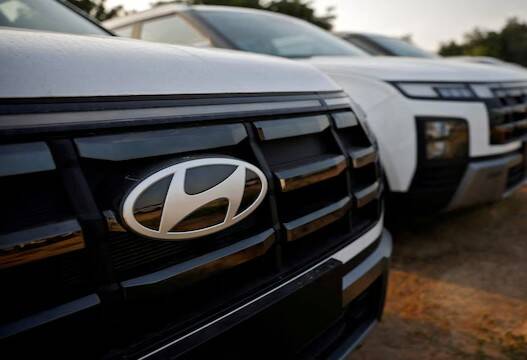
Hyundai Stock Falls 4% After Trump Imposes 25% Tariff on S-Korea
The global automotive industry has been facing numerous challenges in recent years, from shifting consumer preferences to rising trade tensions. The latest development in this regard is the imposition of a 25% tariff on South Korea by the United States, which has sent shockwaves through the stock market. The shares of Hyundai, one of the biggest automobile companies in South Korea, saw a sharp decline on Tuesday, as it fell as much as 4.77% on Tuesday, according to CNBC TV18. This came after Donald Trump imposed a 25% tariff on the Southeast Asian country.
Hyundai’s subsidiary Kia dropped nearly 3.5%, and the affiliated Hyundai Mobis was down 5%. The decline in stock prices is a clear indication of the market’s reaction to the tariffs, which are expected to have a significant impact on the company’s bottom line. The tariffs are likely to increase the cost of importing vehicles and parts from South Korea, which could lead to higher prices for consumers and reduced demand.
The imposition of tariffs on South Korea is part of a broader trade policy initiative by the Trump administration, which has been seeking to reduce the US trade deficit with other countries. The administration has argued that the tariffs are necessary to protect American industries and jobs, but critics have argued that they will have a negative impact on the economy and lead to higher prices for consumers.
The impact of the tariffs on Hyundai and other South Korean automakers is likely to be significant. The company exports a significant portion of its vehicles to the United States, and the tariffs will increase the cost of these exports. This could lead to a decline in sales and revenue for the company, which could have a negative impact on its stock price.
The tariffs are also likely to have a broader impact on the global automotive industry. Many automakers, including Hyundai, have global supply chains that rely on imports from other countries. The tariffs could disrupt these supply chains and lead to higher costs and reduced efficiency.
In addition to the tariffs, the Trump administration has also threatened to impose further tariffs on South Korean auto and pharma industries. This has created uncertainty and volatility in the market, which could lead to further declines in stock prices.
The decline in Hyundai’s stock price is a clear indication of the market’s reaction to the tariffs and the uncertainty surrounding the company’s future prospects. The company’s management will need to navigate this challenging environment and find ways to mitigate the impact of the tariffs on its business.
One possible strategy for Hyundai could be to increase its production in the United States, which would reduce its reliance on imports from South Korea. The company has already announced plans to invest in its US operations, including a new plant in Alabama. However, this will require significant investment and may not be enough to offset the impact of the tariffs.
Another strategy for Hyundai could be to diversify its exports to other countries, which would reduce its reliance on the US market. The company has already been exploring new markets in Asia and Europe, and this could provide a buffer against the impact of the tariffs.
In conclusion, the imposition of a 25% tariff on South Korea by the Trump administration has had a significant impact on Hyundai’s stock price. The company’s management will need to navigate this challenging environment and find ways to mitigate the impact of the tariffs on its business. This could involve increasing production in the United States, diversifying exports to other countries, or finding other ways to reduce its reliance on imports from South Korea.
The impact of the tariffs on the global automotive industry is likely to be significant, and it will be important to monitor developments in this area. The tariffs are part of a broader trade policy initiative by the Trump administration, which has been seeking to reduce the US trade deficit with other countries. However, the tariffs are likely to have a negative impact on the economy and lead to higher prices for consumers.
As the situation continues to evolve, it will be important to stay up to date with the latest developments and analysis. For more information on this topic, please visit the following link: https://www.cnbctv18.com/market/hyundai-shares-take-a-hit-after-trump-threatens-further-hike-in-tariffs-on-s-korean-auto-pharma-industries-19833535.htm/amp
In the meantime, investors and industry observers will be watching closely to see how Hyundai and other affected companies respond to the tariffs. The company’s management will need to be proactive and strategic in its response, and it will be important to monitor the company’s progress in the coming months.
The imposition of tariffs on South Korea is a significant development in the global automotive industry, and it will have far-reaching implications for companies like Hyundai. As the situation continues to evolve, it will be important to stay informed and up to date with the latest news and analysis.
About the Author