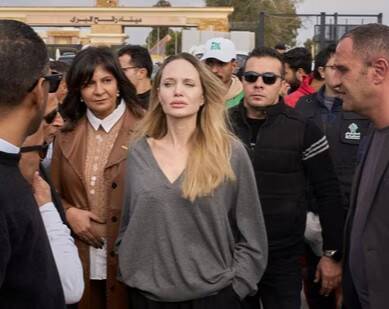
Angelina Jolie Visits Gaza’s Rafah Crossing Amid Israeli Suspension
The Gaza Strip has been a focal point of international attention in recent years, with the region facing numerous challenges, including poverty, lack of access to basic necessities, and limited freedom of movement. The situation has been further complicated by the Israeli government’s recent announcement to suspend aid organizations operating in the Gaza Strip without renewed registrations. Amidst this backdrop, Hollywood actress and former UN special envoy Angelina Jolie visited the Rafah Crossing in Gaza on Friday, highlighting the plight of the people living in the region.
Jolie’s visit to the Rafah Crossing, which is the primary crossing point between Gaza and Egypt, was a significant one, as it brought attention to the difficulties faced by the people of Gaza in accessing basic necessities, including medical supplies. The actress, who has been a long-time advocate for refugee rights and humanitarian causes, was visibly moved by what she saw during her visit. Speaking to reporters, Jolie said, “I walked through a large warehouse that was full of items that were denied entry, most of them medical.” Her statement highlights the severity of the situation, where essential medical supplies are being denied entry, exacerbating the already dire humanitarian situation in Gaza.
The Israeli government’s decision to suspend aid organizations operating in Gaza without renewed registrations has been widely criticized by the international community. The move is seen as an attempt to restrict the flow of aid into the region, further worsening the living conditions of the people of Gaza. The suspension has already started to take effect, with several aid organizations reporting that their operations have been disrupted. This has resulted in a shortage of essential supplies, including food, medicine, and other necessities.
Jolie’s visit to the Rafah Crossing was not just a symbolic gesture; it was a call to action. The actress has been a vocal advocate for the rights of refugees and displaced persons, and her visit to Gaza was a reminder that the international community has a responsibility to ensure that the people of Gaza have access to basic necessities. The visit also highlighted the importance of the role that aid organizations play in providing essential services to the people of Gaza. By suspending these organizations, the Israeli government is not only harming the people of Gaza but also undermining the efforts of the international community to provide humanitarian assistance to the region.
The situation in Gaza is complex, and there are no easy solutions. However, it is clear that the Israeli government’s decision to suspend aid organizations operating in the region is not the answer. Instead, the international community should be working to find ways to increase access to basic necessities, including medical supplies, food, and other essentials. This can be achieved through diplomatic efforts, as well as by providing support to aid organizations operating in the region.
Jolie’s visit to the Rafah Crossing is a reminder that the people of Gaza are not just statistics or headlines; they are human beings who deserve to live with dignity and respect. The international community has a responsibility to ensure that their basic needs are met, and that they have access to the same opportunities as people living in other parts of the world. By highlighting the plight of the people of Gaza, Jolie’s visit is a call to action, urging the international community to take concrete steps to address the humanitarian crisis in the region.
In conclusion, Angelina Jolie’s visit to the Rafah Crossing in Gaza is a significant development, highlighting the difficulties faced by the people of Gaza in accessing basic necessities. The Israeli government’s decision to suspend aid organizations operating in the region without renewed registrations is a move that will only exacerbate the humanitarian crisis. The international community must take concrete steps to address the situation, including providing support to aid organizations operating in the region and working to increase access to basic necessities. By doing so, we can help to alleviate the suffering of the people of Gaza and work towards a more just and equitable solution to the conflict.
About the Author