Trump’s ‘drill baby drill’ energy policy saved AI industry: Huang
The artificial intelligence (AI) industry has been one of the fastest-growing sectors in recent years, with advancements in machine learning, natural language processing, and computer vision. However, according to NVIDIA CEO Jensen Huang, the industry’s growth can be attributed, in part, to the pro-growth energy policy of former US President Donald Trump. In a recent statement, Huang praised Trump’s “drill, baby, drill” policy, saying it saved the AI industry.
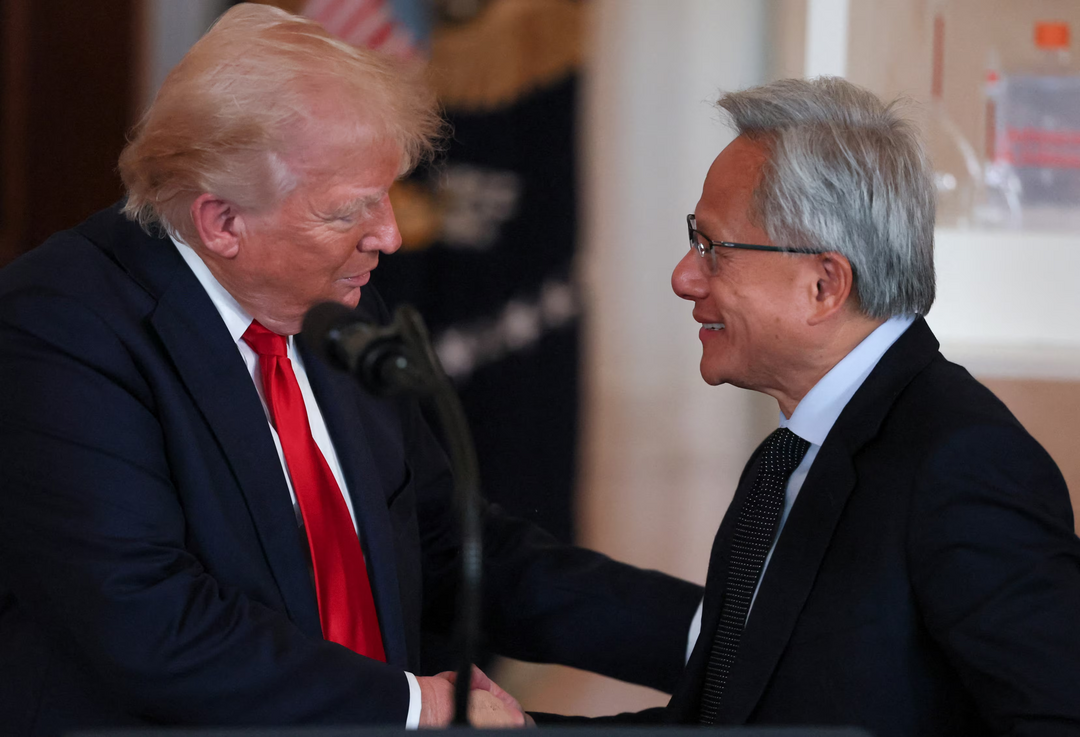
Huang’s comments came after an alleged meeting with Trump, where he expressed his gratitude for the former President’s energy policies. “He came into office and the first thing…he said was ‘drill, baby, drill’. His point is…we need energy growth,” Huang said. “If not for his…policies, we’d not be able to build factories for AI…We surely wouldn’t be able to build supercomputer factories,” he added.
Trump’s “drill, baby, drill” policy was a campaign slogan during his 2016 presidential campaign, which emphasized the need for increased domestic oil and gas production. The policy was aimed at reducing the country’s dependence on foreign oil and creating jobs in the energy sector. While the policy was met with criticism from environmental groups, it has had a significant impact on the US energy industry, with the country becoming one of the world’s largest oil and gas producers.
According to Huang, the increased energy production in the US has been a boon for the AI industry. The development and training of AI models require massive amounts of computational power, which in turn requires large amounts of energy. The increased energy production in the US has made it possible for companies like NVIDIA to build large factories and data centers, which are necessary for the development of AI technologies.
The AI industry has been growing rapidly in recent years, with the global AI market expected to reach $190 billion by 2025. The industry has been driven by advancements in machine learning, natural language processing, and computer vision, which have enabled the development of applications such as chatbots, virtual assistants, and self-driving cars.
NVIDIA has been at the forefront of the AI industry, with its graphics processing units (GPUs) being used in many AI applications. The company’s GPUs are designed to handle the complex mathematical calculations required for AI model training, and have become a key component in many AI systems.
Huang’s comments on Trump’s energy policy have sparked debate in the tech industry, with some experts arguing that the policy has had a negative impact on the environment. However, Huang’s statement highlights the importance of energy production for the growth of the AI industry.
The development of AI technologies requires large amounts of energy, and the increased energy production in the US has made it possible for companies to build large factories and data centers. The construction of these facilities has created jobs and stimulated economic growth, which has had a positive impact on the US economy.
In addition to the economic benefits, the growth of the AI industry has also had a positive impact on society. AI technologies have been used in a variety of applications, including healthcare, finance, and education. For example, AI-powered chatbots have been used to improve customer service in the healthcare industry, while AI-powered virtual assistants have been used to improve student outcomes in education.
The use of AI technologies has also had a positive impact on the environment. For example, AI-powered systems have been used to optimize energy consumption in buildings and data centers, which has reduced greenhouse gas emissions. AI-powered systems have also been used to improve the efficiency of renewable energy sources, such as wind and solar power.
In conclusion, the growth of the AI industry can be attributed, in part, to the pro-growth energy policy of former US President Donald Trump. The increased energy production in the US has made it possible for companies to build large factories and data centers, which are necessary for the development of AI technologies. While the policy has had its critics, the benefits of the policy to the AI industry cannot be denied.
As the AI industry continues to grow and evolve, it is likely that energy production will play an increasingly important role. The development of new AI applications will require even more computational power, which will require even more energy. As such, it is essential that policymakers continue to support the growth of the energy industry, in order to ensure that the AI industry continues to thrive.
About the Author