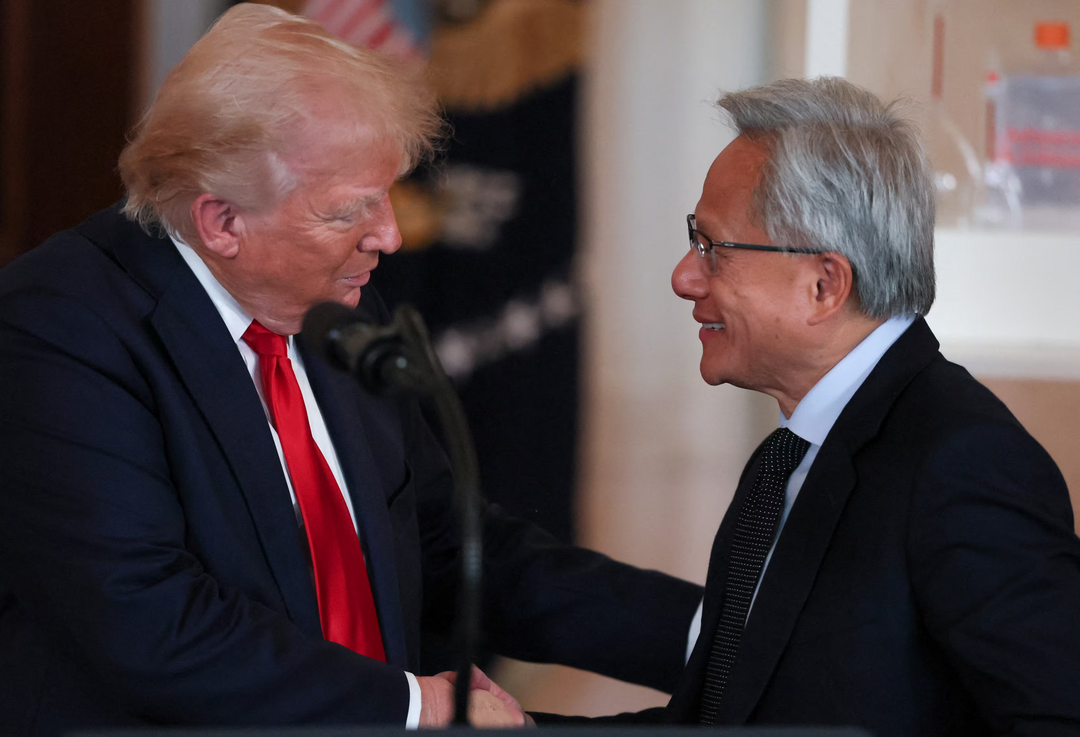
Trump’s ‘drill baby drill’ energy policy saved AI industry: Huang
The artificial intelligence (AI) industry has been rapidly growing over the past decade, with advancements in machine learning, natural language processing, and computer vision. However, according to NVIDIA CEO Jensen Huang, the industry’s growth can be attributed, in part, to the energy policies implemented by former US President Donald Trump. In a recent statement, Huang praised Trump’s pro-growth energy policy, citing his “drill, baby, drill” approach as a crucial factor in the development of the AI industry.
Huang’s comments came after an alleged meeting with Trump, where he expressed his gratitude for the former President’s support of the energy sector. “He came into office and the first thing…he said was ‘drill, baby, drill’. His point is…we need energy growth,” Huang said. “If not for his…policies, we’d not be able to build factories for AI…We surely wouldn’t be able to build supercomputer factories,” he added. This statement highlights the importance of energy availability and affordability in the development of AI technologies.
The “drill, baby, drill” slogan was a hallmark of Trump’s 2016 presidential campaign, emphasizing the need for increased domestic oil and gas production to reduce reliance on foreign energy sources. Trump’s energy policy focused on deregulation, increased drilling on public lands, and the approval of pipelines such as the Keystone XL. These efforts led to a significant increase in US oil and gas production, making the country a net exporter of energy for the first time in decades.
The impact of Trump’s energy policy on the AI industry may not be immediately apparent. However, the relationship between energy availability and AI development is more closely tied than one might think. AI technologies, such as deep learning and natural language processing, require massive amounts of computational power to train and deploy. This computational power is typically provided by large data centers and supercomputers, which consume enormous amounts of energy.
The construction and operation of these data centers and supercomputers require a reliable and affordable source of energy. Trump’s pro-growth energy policy, which aimed to increase domestic energy production and reduce regulatory barriers, helped to ensure a stable and affordable energy supply. This, in turn, enabled companies like NVIDIA to build and operate the large-scale data centers and supercomputers necessary for AI development.
Huang’s comments also highlight the importance of industrial policy in supporting the growth of emerging technologies like AI. By promoting energy growth and reducing regulatory barriers, Trump’s administration created an environment that allowed companies to invest in AI research and development. This investment has paid off, with the AI industry experiencing rapid growth and innovation over the past few years.
The impact of Trump’s energy policy on the AI industry can also be seen in the development of new technologies and applications. For example, the increased availability of energy has enabled the widespread adoption of cloud computing, which has been a key driver of AI innovation. Cloud computing allows companies to access large amounts of computational power and storage on demand, without the need for significant upfront investment in hardware.
Furthermore, the growth of the AI industry has also been driven by advances in fields like computer vision and natural language processing. These technologies require large amounts of data and computational power to train and deploy, which has been enabled by the increased availability of energy. The development of new AI applications, such as autonomous vehicles and smart homes, has also been facilitated by the growth of the energy sector.
In conclusion, NVIDIA CEO Jensen Huang’s comments highlight the important role that Trump’s energy policy played in the development of the AI industry. By promoting energy growth and reducing regulatory barriers, Trump’s administration created an environment that allowed companies to invest in AI research and development. The increased availability of energy has enabled the widespread adoption of cloud computing, the development of new AI technologies and applications, and the growth of the AI industry as a whole.
As the AI industry continues to grow and evolve, it is essential to recognize the importance of industrial policy in supporting emerging technologies. The relationship between energy availability and AI development is complex and multifaceted, and policymakers must consider the impact of energy policy on the growth and development of the AI industry.
In the future, it will be essential to balance the need for energy growth with concerns about climate change and environmental sustainability. As the world transitions to a more sustainable energy mix, it is crucial to ensure that the energy sector continues to support the growth and development of emerging technologies like AI.
About the Author