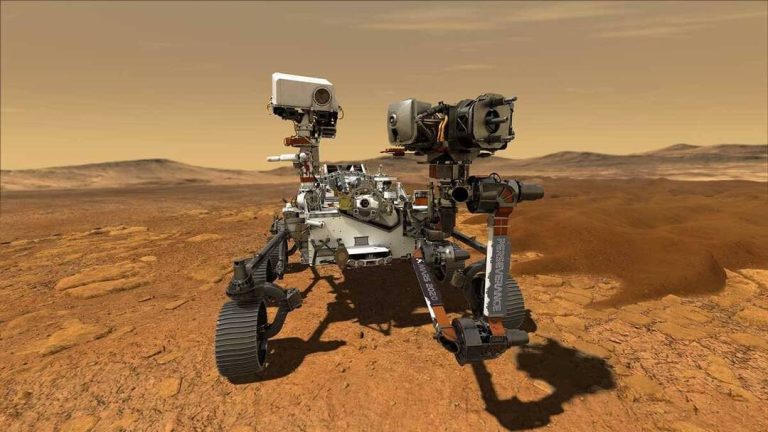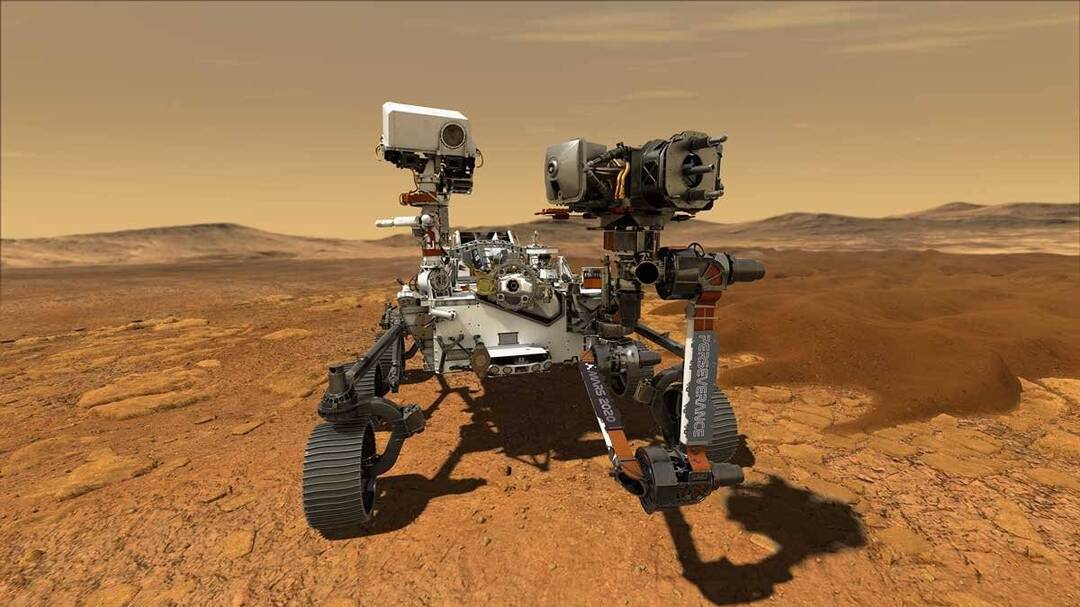
NASA’s Perseverance rover completes 1st AI-planned drive on Mars
In a significant milestone for space exploration, NASA’s Perseverance rover has completed its first drive on Mars that was planned by artificial intelligence. This historic demonstration, which took place on December 8 and 10, was led by NASA’s Jet Propulsion Laboratory in Southern California. The successful AI-planned drive marks a major advancement in the capabilities of the Perseverance rover and paves the way for more efficient and effective exploration of the Martian surface.
The Perseverance rover, which landed on Mars in February 2021, is equipped with a range of advanced instruments and technologies designed to help scientists better understand the Martian environment and search for signs of past or present life on the Red Planet. One of the key technologies on board the rover is its autonomous navigation system, which enables the rover to plan and execute its own drives without the need for direct human intervention.
The AI-planned drive demonstration was a key test of the Perseverance rover’s autonomous navigation capabilities. During the demonstration, the rover’s AI system was tasked with planning a drive route across a complex and rocky terrain, taking into account a range of factors such as the rover’s power levels, communication windows, and scientific objectives. The AI system used a combination of machine learning algorithms and data from the rover’s instruments to plan the drive route, which was then executed by the rover’s autonomous navigation system.
According to NASA, the demonstration was a major success, with the rover completing the drive route as planned and gathering valuable scientific data along the way. The success of the demonstration is a testament to the advanced capabilities of the Perseverance rover and the significant progress that has been made in the development of autonomous navigation systems for space exploration.
“This demonstration shows how far our capabilities have advanced and broadens how we will explore other worlds,” said NASA Administrator Jared Isaacman. “The use of artificial intelligence and autonomous navigation systems will play a critical role in future space missions, enabling us to explore more efficiently and effectively, and to make new discoveries that will help us better understand the universe.”
The completion of the first AI-planned drive on Mars is a significant milestone for the Perseverance rover mission, which is designed to search for signs of past or present life on Mars and to gather data that will help scientists better understand the Martian environment. The mission is also designed to test technologies that will be used in future Mars missions, including the use of autonomous navigation systems and artificial intelligence.
The use of artificial intelligence and autonomous navigation systems on the Perseverance rover has a number of benefits, including increased efficiency and productivity, improved safety, and enhanced scientific return. By enabling the rover to plan and execute its own drives, the AI system can help to reduce the workload of human operators and free up more time for scientific research and analysis.
The success of the AI-planned drive demonstration also highlights the potential for future Mars missions to use autonomous navigation systems and artificial intelligence to explore the Martian surface. As NASA and other space agencies plan for future missions to Mars and beyond, the use of autonomous navigation systems and artificial intelligence will play an increasingly important role in enabling more efficient and effective exploration of the solar system.
In addition to the AI-planned drive demonstration, the Perseverance rover has also been conducting a range of scientific experiments and gathering data on the Martian environment. The rover is equipped with a range of instruments, including cameras, spectrometers, and radar systems, which are designed to help scientists better understand the Martian geology, climate, and potential biosignatures.
The Perseverance rover is also equipped with a sample collection system, which is designed to gather and store samples of Martian rock and soil for potential return to Earth on a future mission. The samples will be stored in tubes and sealed, and will provide scientists with a unique opportunity to study the Martian geology and search for signs of past or present life on the Red Planet.
In conclusion, the completion of the first AI-planned drive on Mars is a significant milestone for the Perseverance rover mission and a major advancement in the capabilities of autonomous navigation systems for space exploration. The success of the demonstration highlights the potential for future Mars missions to use artificial intelligence and autonomous navigation systems to explore the Martian surface, and paves the way for more efficient and effective exploration of the solar system.
About the Author