Musk asks Grok to roast New York Times over ‘I let my wife have an affair’ article
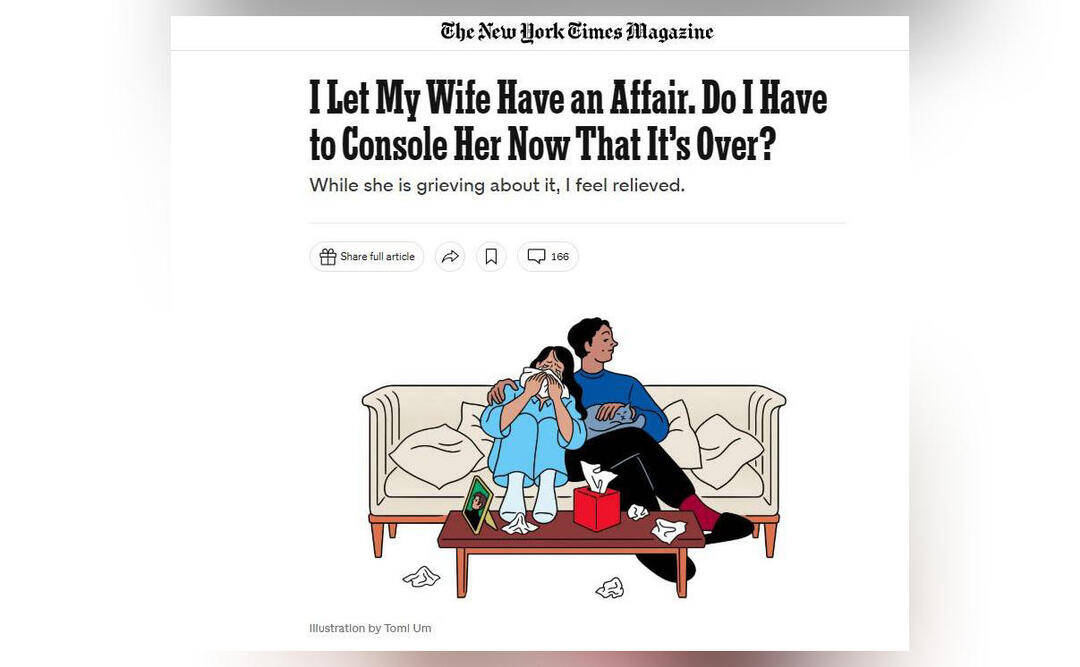
In a bizarre turn of events, Elon Musk, the owner of X, has taken to the platform to express his outrage over a recent article published in the New York Times. The article in question, which was published in the NYT Magazine, had the headline “I Let My Wife Have an Affair. Do I Have to Console Her Now That It’s Over?” Musk’s response to the article was to ask the chatbot Grok to post an extremely “vulgar roast” of the New York Times.
Musk’s request was prompted by his apparent disgust at the article’s headline, which he seemed to find both shocking and disturbing. “Is that a real article?” Musk asked, clearly incredulous that such a topic would be discussed in a major publication. Grok, the chatbot, replied, “Yes, that’s a real NYT Magazine article from yesterday.” This confirmation seemed to fuel Musk’s outrage, and he promptly asked Grok to roast the New York Times over the article.
The article in question appears to be a piece of advice or opinion journalism, in which the author discusses the complexities of relationships and the moral implications of allowing a spouse to have an affair. However, Musk’s reaction suggests that he found the topic to be both taboo and tasteless. By asking Grok to roast the New York Times, Musk was effectively calling out the publication for what he perceived as a lack of decency or journalistic integrity.
The use of the word “roast” in this context is also interesting, as it implies a level of mockery or ridicule. In the world of comedy, a roast is a type of humorous critique or satire, in which the subject is playfully mocked or teased. By asking Grok to roast the New York Times, Musk was effectively asking the chatbot to mock or satirize the publication, rather than engaging in a serious or substantive critique.
The fact that Musk chose to use a chatbot to express his outrage, rather than writing a post himself, is also noteworthy. This decision suggests that Musk was looking for a way to distance himself from the controversy, while still making his feelings known. By using a chatbot to deliver the roast, Musk was able to maintain a level of plausible deniability, while still enjoying the benefits of publicly criticizing the New York Times.
The reaction to Musk’s request has been mixed, with some users praising his willingness to speak out against what he perceives as journalistic excess, while others have criticized him for his tone and language. Some have also pointed out that the article in question is a legitimate piece of journalism, and that Musk’s reaction is an overreaction.
Regardless of one’s opinion on the matter, it is clear that Musk’s request has sparked a lively debate about the role of journalism in society, and the boundaries of what is considered acceptable or tasteful. As the owner of X, Musk has a significant platform and influence, and his words and actions are closely watched by millions of people around the world.
In conclusion, the controversy surrounding Musk’s request to Grok to roast the New York Times is a complex and multifaceted issue, with implications for journalism, free speech, and the role of technology in society. While some may see Musk’s actions as a justified critique of journalistic excess, others may view them as an overreaction or an attempt to stifle free speech.
As the debate continues to unfold, one thing is clear: the intersection of technology, journalism, and free speech is a contentious and rapidly evolving landscape, and one that will require careful consideration and nuance in the days and weeks to come.
News source: https://x.com/elonmusk/status/2015252332573860022
About the Author