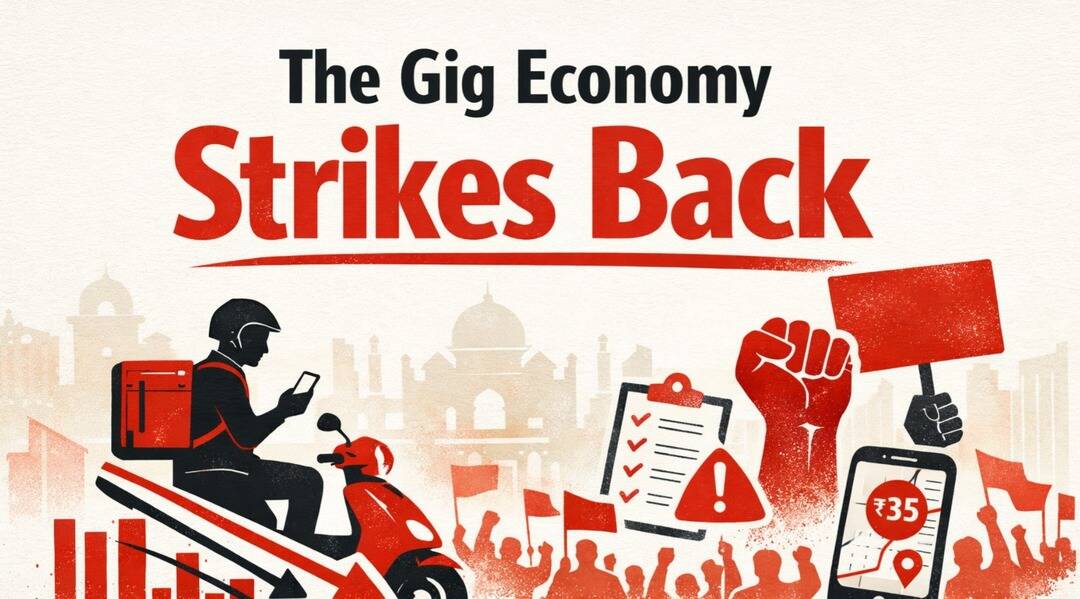
Indian gig economy strikes back, exposing a broken model
The Indian gig economy, which has been booming in recent years, has hit a roadblock. In December, around 40,000 delivery workers joined nationwide strikes, disrupting 50–60% of orders in several cities. The workers, who are the backbone of the gig economy, cited low and unstable pay, strict app control, and weak protections as the reasons for their strike. This sudden outbreak of protests has brought to light the widening gap between convenience and fairness in India’s digital jobs.
The gig economy, which includes companies like Zomato, Swiggy, and Uber, has been growing rapidly in India. These companies have made it convenient for people to order food, book cabs, and avail other services with just a few clicks on their smartphones. However, behind the scenes, the workers who make this convenience possible have been struggling to make ends meet. They work long hours, often in harsh weather conditions, and are paid meager amounts that are barely enough to cover their expenses.
The strike, which was called by various worker unions, was a culmination of the growing discontent among the workers. They demanded better pay, more flexible working hours, and stronger protections from the companies they work for. The workers also complained about the strict control exerted by the companies through their apps, which dictate everything from the routes they take to the time they have to deliver an order. Any deviation from the app’s instructions can result in penalties, including a reduction in pay or even termination of employment.
The companies, on the other hand, have been defensive about their business model. They claim that they provide flexible working opportunities to thousands of workers, who can choose when and how much they want to work. They also argue that their apps are designed to ensure that orders are delivered efficiently and that customers receive a good experience. However, the workers counter that the flexibility is an illusion, as they are often forced to work long hours to make a decent living.
The strike has also drawn the attention of politicians, who have intervened in the matter. Some have called for stronger regulations to protect the rights of gig workers, while others have urged the companies to increase pay and improve working conditions. The government has also announced plans to introduce new laws to regulate the gig economy, which could potentially address some of the concerns raised by the workers.
However, the question remains whether these measures will be enough to address the underlying issues with the gig economy. The model, which is based on hiring workers as independent contractors rather than employees, has been criticized for creating a class of precarious workers who lack basic rights and protections. The companies benefit from this arrangement, as they do not have to provide benefits, paid time off, or job security to their workers.
The Indian gig economy is not unique in this regard. Globally, the gig economy has been criticized for creating a culture of exploitation, where workers are treated as disposable commodities rather than human beings. The companies, which are often valued in billions of dollars, have a responsibility to ensure that their workers are treated fairly and with dignity.
In India, the gig economy has grown rapidly, with millions of workers joining the sector in recent years. However, the lack of regulations and protections has created a Wild West scenario, where companies can exploit workers with impunity. The strike by delivery workers is a wake-up call for the government, companies, and society as a whole to recognize the value of these workers and to ensure that they are treated fairly.
As the gig economy continues to grow, it is essential to address the concerns raised by the workers. This includes providing better pay, more flexible working hours, and stronger protections. The companies must also be held accountable for their actions, and the government must introduce regulations to prevent exploitation. Only then can we ensure that the gig economy is a force for good, providing opportunities for workers to earn a decent living and improve their lives.
In conclusion, the Indian gig economy strike is a significant event that highlights the broken model of the sector. The workers’ demands for better pay, more flexibility, and stronger protections are reasonable and must be addressed. The companies, government, and society as a whole must recognize the value of these workers and ensure that they are treated fairly. Only then can we create a gig economy that is fair, equitable, and sustainable for all.
Source: https://ascendants.in/industry_events/indian-gig-economy-strikes-platforms-policy/
About the Author