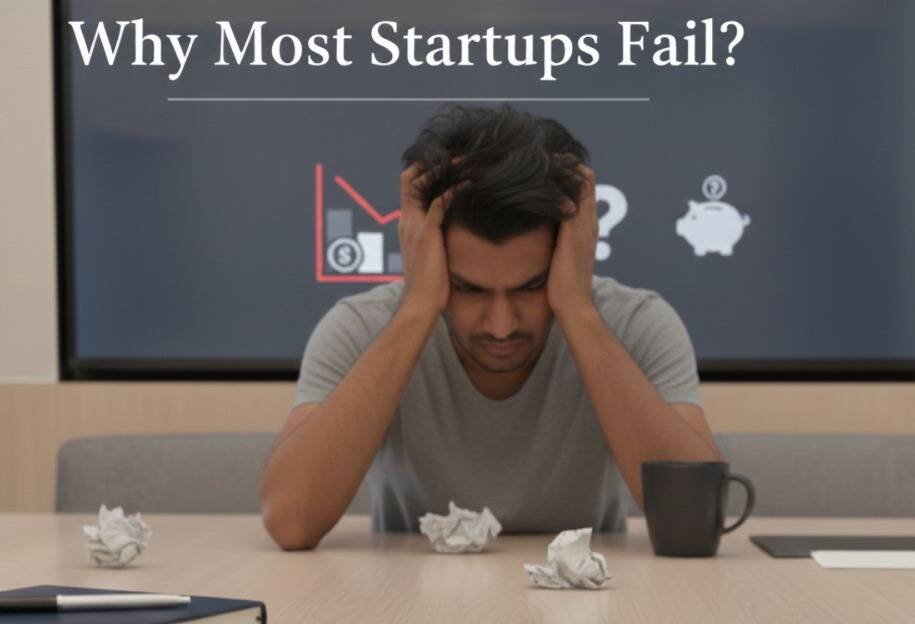
Why most startups fail despite big ideas and funding?
The startup ecosystem is bustling with innovative ideas, talented founders, and generous funding. However, despite these favorable conditions, a significant number of startups fail to take off or sustain themselves in the long run. The question that arises is, what goes wrong? Is it the lack of a strong idea, insufficient funding, or something more fundamental?
According to founders and industry leaders, the reasons for startup failure are more nuanced and often rooted in poor fundamentals. A lack of real market demand, uncontrolled cash burn, and weak execution are cited as the biggest reasons why startups fail, despite having big ideas and funding. In this article, we will delve into these three key mistakes that startups make, which ultimately lead to their downfall.
Lack of Real Market Demand
One of the primary reasons startups fail is that they often create solutions for problems that don’t exist or are not significant enough to warrant a solution. Many founders fall in love with their ideas and assume that the market will too, without conducting thorough customer validation. This can lead to a product or service that doesn’t meet the needs of the target audience, resulting in poor sales and eventual shutdown.
Startups that skip customer validation or fail to gather feedback from potential customers are more likely to fail. It’s essential to understand the needs, preferences, and pain points of the target audience and create a solution that addresses these issues. Conducting market research, gathering feedback, and iterating on the product or service based on customer input can help startups create something that meets the demands of the market.
Uncontrolled Cash Burn
Another significant reason startups fail is that they often overspend before generating revenue. This can be due to a variety of factors, including hiring too many employees too quickly, spending excessively on marketing and advertising, or investing in unnecessary infrastructure. When startups burn through their cash reserves too quickly, they can find themselves in a difficult financial situation, with limited options for raising additional capital.
Startups that fail to manage their finances effectively often struggle to stay afloat. It’s essential to create a realistic budget, prioritize spending, and ensure that the startup is generating revenue before scaling up operations. This can involve adopting a lean startup approach, where the focus is on creating a minimum viable product (MVP) and iterating on it based on customer feedback, rather than trying to create a fully-fledged product or service from the outset.
Weak Execution
Finally, weak execution is another key reason why startups fail. This can manifest in a variety of ways, including poor management, inadequate systems and processes, and a lack of adaptability. Startups that fail to execute their plans effectively often struggle to deliver their product or service to market, which can lead to a loss of credibility and reputation.
Startups that are unable to adapt quickly to changing market conditions or customer needs are also more likely to fail. The ability to pivot or adjust the business model in response to feedback or changing circumstances is critical for startup success. This requires a flexible and agile approach, where the focus is on continuous learning and improvement, rather than being wedded to a particular idea or approach.
Conclusion
In conclusion, startups fail not because their ideas are weak, but due to poor fundamentals. A lack of real market demand, uncontrolled cash burn, and weak execution are the biggest reasons why startups fail, despite having big ideas and funding. Startups that skip customer validation, overspend before revenue, or fail to adapt quickly often shut down, despite strong technology, funding interest, or early buzz.
To avoid these common pitfalls, startups should focus on creating solutions that meet the needs of their target audience, managing their finances effectively, and executing their plans with agility and adaptability. By prioritizing these fundamentals, startups can increase their chances of success and create a sustainable business that delivers value to customers and stakeholders.
For more information on why most startups fail, visit: https://ascendants.in/industry_events/why-most-startups-fail-3-key-mistakes/
News Source: https://ascendants.in/industry_events/why-most-startups-fail-3-key-mistakes/
About the Author