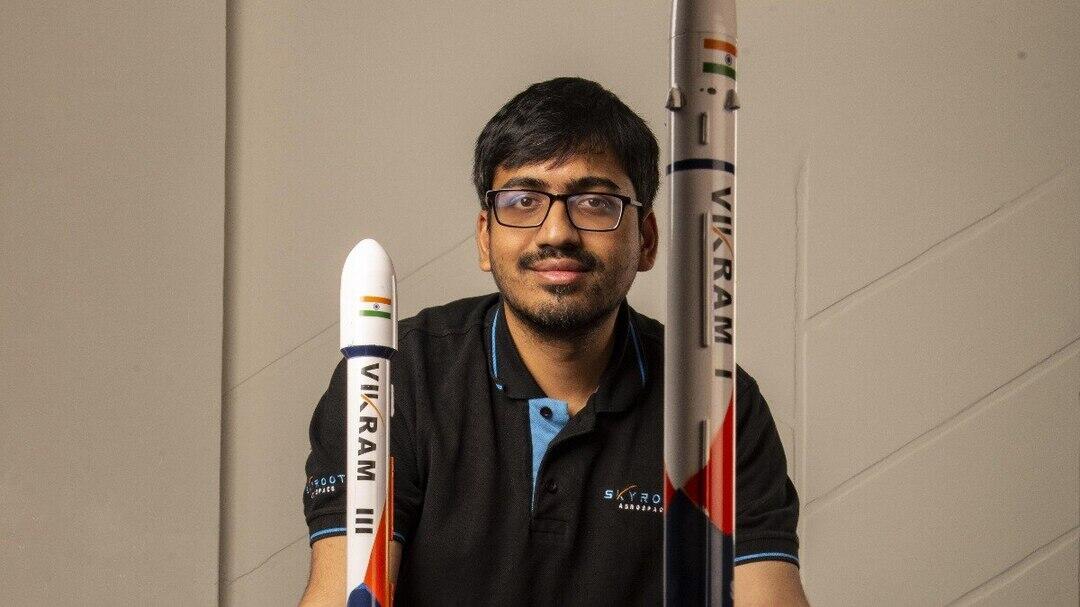
PK Chandana, who launched India’s 1st private rocket, scored 51 in maths; later cleared JEE
The world of science and technology is full of inspiring stories of individuals who have overcome incredible odds to achieve greatness. One such story is that of Pawan Kumar Chandana, also known as PK Chandana, the co-founder of Skyroot Aerospace, a company that has made history by launching India’s first private rocket into space. What’s even more remarkable about Chandana’s story is that he was an average student who scored just 51 marks in mathematics, a subject that is crucial for a career in aerospace engineering.
According to Deedy Das, Chandana’s journey to success is a testament to the power of perseverance and hard work. Despite his poor performance in mathematics, Chandana’s father did not give up on him. Instead, he got him enrolled in IIT-JEE coaching, which proved to be a turning point in Chandana’s academic career. With the help of his coaching, Chandana improved significantly in science and mathematics, and his interest in these subjects grew exponentially.
In 2007, Chandana’s hard work paid off when he joined the prestigious Indian Institute of Technology (IIT) in Kharagpur. This was a major milestone in his academic journey, and it laid the foundation for his future success. At IIT-Kharagpur, Chandana was exposed to a rigorous academic environment that helped him develop his skills and knowledge in aerospace engineering.
After completing his education, Chandana went on to work with several top companies in the aerospace industry, including ISRO and Airbus. However, he soon realized that his true passion lay in building his own company, and he co-founded Skyroot Aerospace with his friend and colleague, Bharath Daka. The company’s mission was to develop and launch private rockets into space, a feat that had never been achieved by an Indian company before.
The journey to launching India’s first private rocket was not an easy one. Chandana and his team faced numerous challenges, including funding issues, technological hurdles, and regulatory obstacles. However, they persevered and worked tirelessly to overcome these challenges. Their hard work paid off on November 18, 2022, when Skyroot Aerospace successfully launched its first private rocket, Vikram-S, into space.
The launch of Vikram-S was a historic moment for India, marking a major milestone in the country’s space program. It was also a testament to the power of innovation and entrepreneurship in the private sector. Chandana’s story is an inspiration to millions of young Indians who dream of making a career in science and technology.
Chandana’s success is also a reminder that academic performance is not the only determinant of success. Many successful individuals have overcome poor academic performance to achieve greatness in their fields. What is more important than academic grades is the passion, dedication, and hard work that one puts into their work.
In an interview, Chandana credited his father for his success, saying that his father’s support and encouragement helped him to pursue his dreams. He also emphasized the importance of taking risks and trying new things, saying that this is the only way to achieve true innovation and success.
Chandana’s story is also a testament to the growing importance of the private sector in India’s space program. For decades, India’s space program has been dominated by the government-owned Indian Space Research Organisation (ISRO). However, in recent years, the private sector has begun to play a major role in the development of space technology. Companies like Skyroot Aerospace, Agnikul Cosmos, and Pixxel are pushing the boundaries of innovation and entrepreneurship in the space sector.
The launch of India’s first private rocket is a major milestone in the country’s space program, and it marks a new era of cooperation between the government and the private sector. The government has announced several initiatives to support the growth of the private space sector, including the establishment of a new space regulator and the provision of funding for start-ups.
In conclusion, PK Chandana’s story is an inspiration to millions of young Indians who dream of making a career in science and technology. His journey from being an average student to launching India’s first private rocket into space is a testament to the power of perseverance, hard work, and innovation. Chandana’s success is also a reminder that academic performance is not the only determinant of success, and that passion, dedication, and risk-taking are essential for achieving true greatness.
About the Author