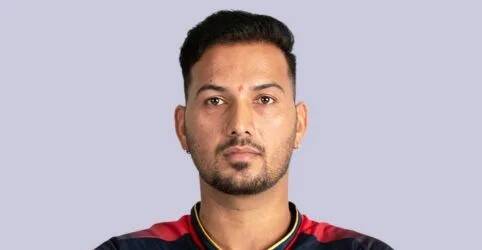
Cricketer Rajan Kumar, who was part of RCB in IPL 2024, fails dope test
The world of cricket has been shaken once again by a doping scandal, as Uttarakhand left-arm fast bowler Rajan Kumar has failed a dope test. The National Anti-Doping Agency (NADA) has imposed a provisional suspension on the young cricketer, who was part of the Royal Challengers Bangalore (RCB) squad in the Indian Premier League (IPL) 2024. This news has sent shockwaves through the cricketing community, raising concerns about the use of performance-enhancing substances in the sport.
According to reports, Rajan Kumar tested positive for Drostanolone, Metenolone, and Clomiphene, all of which are anabolic steroids. These substances are banned by the World Anti-Doping Agency (WADA) and are considered to be performance-enhancing drugs. The use of such substances can give a player an unfair advantage over others, which is against the spirit of the game.
Rajan Kumar’s rise to fame was rapid, and he was considered one of the most promising young bowlers in the country. He took 13 wickets in the Syed Mushtaq Ali Trophy 2025, which is a impressive feat for any bowler. His performance in the tournament caught the attention of the RCB team management, who signed him up for the IPL 2024. However, his career has now been put on hold due to the doping scandal.
The NADA has a strict policy against doping, and any player who tests positive for a banned substance is subject to a provisional suspension. The suspension can be lifted if the player is able to prove that they did not intentionally take the substance, but the burden of proof lies with the player. In this case, Rajan Kumar will have to provide evidence to prove that he did not knowingly take the substances, which is a daunting task.
The use of performance-enhancing substances is a serious issue in cricket, and it is not the first time that a player has been caught doping. In the past, several high-profile players have been banned for doping, including some who have played for the Indian national team. The BCCI has a zero-tolerance policy towards doping, and any player who is found guilty of doping can face severe penalties, including a life ban from the sport.
The news of Rajan Kumar’s doping scandal has raised questions about the effectiveness of the doping control system in Indian cricket. While the NADA has been doing a good job of testing players and catching those who dope, there is still a lot of work to be done to prevent doping in the sport. The BCCI and the NADA need to work together to educate players about the dangers of doping and to ensure that the doping control system is robust and effective.
In addition, the doping scandal has also raised questions about the role of support staff, including coaches and trainers, in preventing doping. While players are ultimately responsible for their own actions, support staff can play a crucial role in educating players about the dangers of doping and in monitoring their behavior. The BCCI and the NADA need to ensure that support staff are aware of their responsibilities and are held accountable for any wrongdoing.
In conclusion, the doping scandal involving Rajan Kumar is a setback for Indian cricket, and it highlights the need for a robust doping control system. The BCCI and the NADA need to work together to prevent doping in the sport, and players need to be aware of the dangers of performance-enhancing substances. The news of Rajan Kumar’s doping scandal is a reminder that doping is a serious issue in cricket, and it needs to be addressed urgently.
News Source: https://x.com/kushansarkar/status/2008197106234991093
About the Author