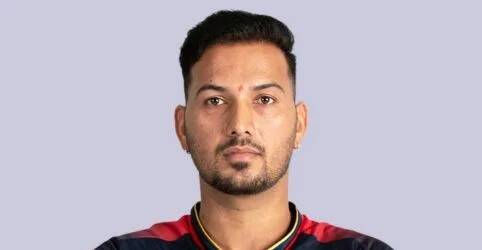
Cricketer Rajan Kumar, who was part of RCB in IPL 2024, fails dope test
The world of cricket has been shaken by yet another doping scandal, this time involving a young and promising player from Uttarakhand. Rajan Kumar, a left-arm fast bowler who was part of the Royal Challengers Bangalore (RCB) squad in the Indian Premier League (IPL) 2024, has failed a dope test. The National Anti-Doping Agency (NADA) has imposed a provisional suspension on the cricketer, pending further investigation and a final verdict.
According to reports, Rajan Kumar tested positive for Drostanolone, Metenolone, and Clomiphene, all of which are anabolic steroids. These substances are banned by the World Anti-Doping Agency (WADA) and are considered performance-enhancing drugs. The test was conducted during a domestic tournament, and the results have sent shockwaves through the cricketing community.
Rajan Kumar’s rise to prominence was rapid, and he had been making waves in the cricketing circuit with his impressive performances. In the Syed Mushtaq Ali Trophy 2025, he took 13 wickets, showcasing his talent and potential. His selection in the RCB squad for IPL 2024 was seen as a testament to his hard work and dedication to the sport.
However, the doping scandal has now put a question mark over his career. The provisional suspension imposed by NADA means that Rajan Kumar will not be able to participate in any cricketing activities until the investigation is complete and a final decision is made. This is a significant setback for the young cricketer, who had been touted as a future star of Indian cricket.
The use of performance-enhancing drugs is a serious issue in sports, and cricket is no exception. The International Cricket Council (ICC) and the Board of Control for Cricket in India (BCCI) have strict anti-doping policies in place, and any player found guilty of doping faces severe penalties, including suspension and even a lifetime ban.
The news of Rajan Kumar’s doping scandal has sparked a debate about the prevalence of doping in cricket. While some have expressed shock and disappointment, others have pointed out that the problem is more widespread than we think. The fact that a young player like Rajan Kumar, who was on the cusp of a promising career, has been caught doping raises questions about the pressures and temptations that players face in the high-stakes world of professional cricket.
The BCCI and the ICC have a responsibility to ensure that the sport is clean and fair, and that players are not tempted to use performance-enhancing drugs to gain an unfair advantage. This includes educating players about the dangers of doping, providing support and resources to help them make informed choices, and enforcing strict penalties for those who are caught doping.
In the case of Rajan Kumar, the provisional suspension is just the beginning of a long and uncertain process. The NADA will conduct a thorough investigation, and the player will have the opportunity to present his case and defend himself against the charges. If found guilty, he faces a lengthy suspension, which could potentially end his cricketing career.
As the cricketing community waits with bated breath for the outcome of the investigation, one thing is clear: the doping scandal involving Rajan Kumar is a wake-up call for the sport. It highlights the need for vigilance and strict enforcement of anti-doping policies, as well as the importance of educating players about the risks and consequences of doping.
The incident also raises questions about the role of support staff, coaches, and mentors in preventing doping. Do they have a responsibility to educate players about the dangers of doping, and to encourage them to make informed choices? Or are they sometimes complicit in the use of performance-enhancing drugs, either actively or passively?
As the investigation into Rajan Kumar’s doping scandal continues, the cricketing community will be watching with interest. The outcome will have significant implications not just for the player, but for the sport as a whole. It is a reminder that cricket, like any other sport, is not immune to the scourge of doping, and that constant vigilance is needed to protect the integrity of the game.
In conclusion, the doping scandal involving Rajan Kumar is a serious blow to the cricketing community. It highlights the need for strict anti-doping policies, education, and enforcement, as well as the importance of supporting players in making informed choices. As the investigation continues, one thing is clear: the sport of cricket must remain vigilant and committed to fairness and integrity.
News source: https://x.com/kushansarkar/status/2008197106234991093
About the Author