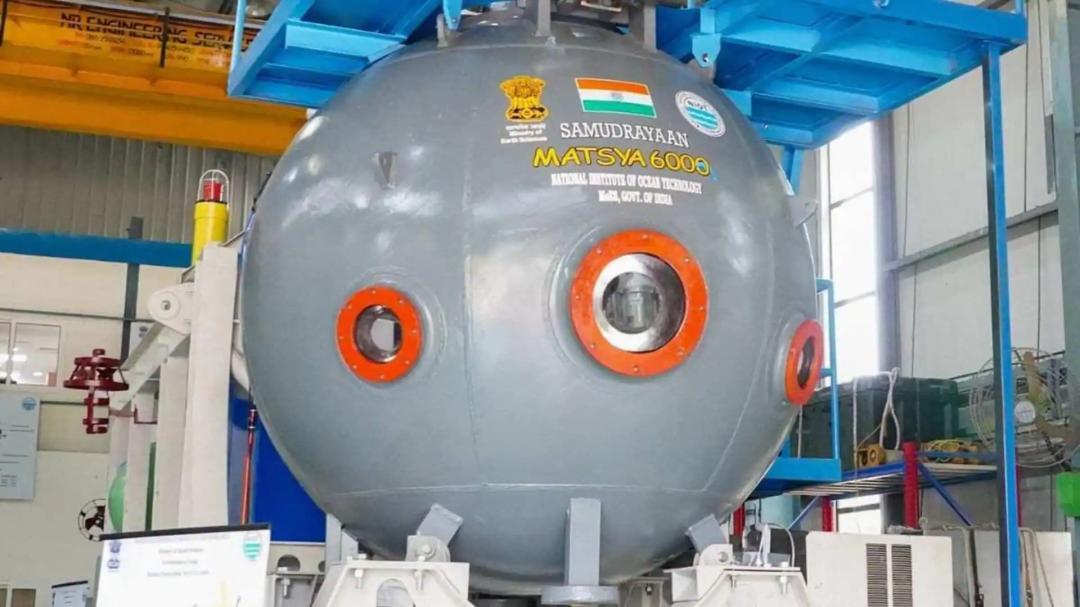
What is causing the delay in India’s Samudrayaan mission?
India’s ambitious Samudrayaan mission, aimed at sending a manned submersible to a depth of 6,000 meters underwater, has hit a roadblock. The mission, led by the National Institute of Ocean Technology (NIOT), has been delayed due to the late delivery of a critical component – syntactic foam cladding – from France. This vital component is essential for the submersible’s buoyancy, and its delayed arrival has pushed back the mission’s timeline.
The Samudrayaan mission is a pioneering effort by India to explore the ocean floor, collect samples, and pave the way for deep-sea mining. The mission is expected to play a significant role in enhancing our understanding of the ocean’s ecosystem and unlocking its vast resources. However, the delay in the delivery of the syntactic foam cladding has thrown a spanner in the works, and the tests are now expected to commence by April next year.
So, what exactly is syntactic foam cladding, and why is it so crucial for the Samudrayaan mission? Syntactic foam is a type of composite material that is made up of hollow glass microspheres dispersed in a polymer matrix. It is extremely lightweight, yet incredibly strong, making it an ideal material for use in deep-sea submersibles. The syntactic foam cladding is used to provide buoyancy to the submersible, allowing it to withstand the crushing pressure of the deep ocean.
The Samudrayaan mission is a complex and challenging undertaking that requires the development of a range of advanced technologies. The submersible itself is a sophisticated vessel that must be able to withstand the extreme conditions of the deep ocean, including near-freezing temperatures, crushing pressure, and total darkness. The crew module, where the pilots will be seated, must be able to maintain a safe internal environment, despite the hostile conditions outside.
The delay in the delivery of the syntactic foam cladding is a significant setback for the Samudrayaan mission. The mission team had been working tirelessly to meet the original deadline, and the delay will inevitably push back the entire project timeline. However, the NIOT team is working closely with the French suppliers to expedite the delivery of the syntactic foam cladding, and the tests are expected to commence by April next year.
The Samudrayaan mission is not just about exploring the ocean floor; it is also about unlocking the vast resources that lie beneath the waves. The ocean is a treasure trove of minerals, including copper, zinc, and gold, and the Samudrayaan mission is expected to play a key role in identifying and extracting these resources. The mission will also help to enhance our understanding of the ocean’s ecosystem, including the unique creatures that inhabit the deep sea.
In addition to its scientific and economic benefits, the Samudrayaan mission is also expected to have significant strategic implications. The ability to explore and exploit the ocean’s resources will give India a significant advantage in the global arena, and will help to enhance the country’s position as a major maritime power.
In conclusion, the delay in the Samudrayaan mission is a setback, but it is not a showstopper. The NIOT team is working hard to overcome the challenges, and the tests are expected to commence by April next year. The Samudrayaan mission is a vital component of India’s oceanic endeavors, and its success will have far-reaching implications for the country’s scientific, economic, and strategic interests.
About the Author