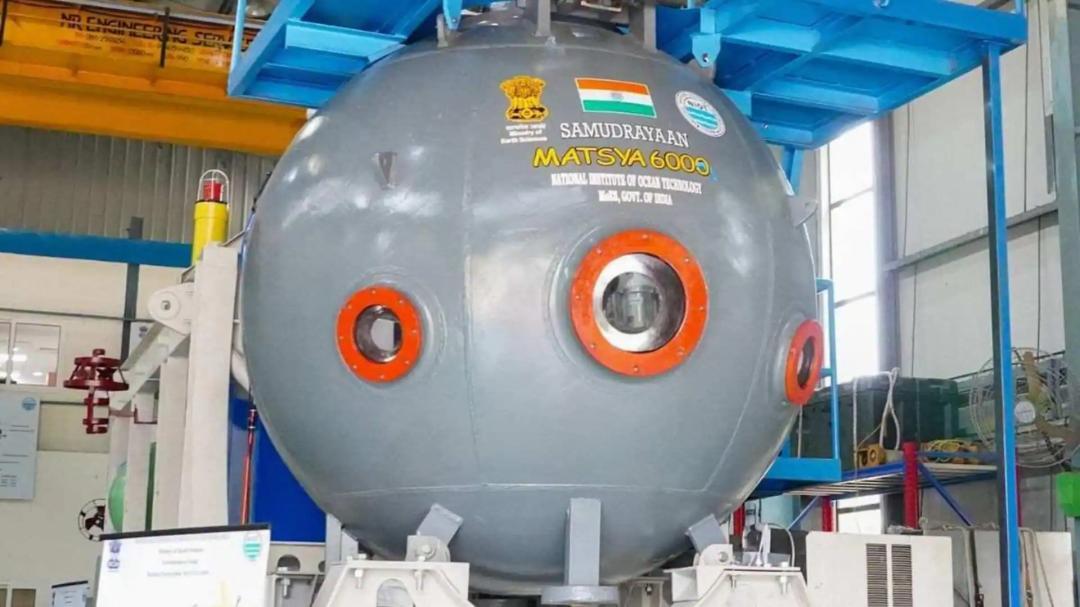
What is causing the delay in India’s Samudrayaan mission?
The Indian government’s ambitious Samudrayaan mission, which aims to send a manned submersible to a depth of 6,000 meters underwater, has hit a roadblock. The mission, led by the National Institute of Ocean Technology (NIOT), has been delayed due to the late delivery of a critical component from France. The component in question is syntactic foam cladding, which is vital for the submersible’s buoyancy. The delay has pushed back the testing schedule, with trials now expected to commence by April next year.
The Samudrayaan mission is a significant undertaking for India, with the potential to unlock new avenues for deep-sea exploration, research, and even mining. The mission’s primary objective is to design, develop, and test a manned submersible that can withstand the extreme conditions found at depths of 6,000 meters. The submersible will be equipped with state-of-the-art technology, including advanced life support systems, communication equipment, and sampling gear.
One of the critical components of the submersible is the syntactic foam cladding, which provides the necessary buoyancy to maintain the vehicle’s stability and balance underwater. The foam cladding is designed to withstand the crushing pressure of the deep sea, while also providing insulation and reducing the risk of water ingress. The NIOT had ordered the syntactic foam cladding from a French company, which was expected to deliver the component on time. However, the delivery has been delayed, causing a ripple effect on the entire mission schedule.
The delay in the delivery of the syntactic foam cladding has significant implications for the Samudrayaan mission. The NIOT had planned to conduct a series of tests and trials to validate the submersible’s design and performance. These tests were scheduled to take place in the coming months, with the aim of deploying the submersible in the deep sea by the end of the year. However, with the delay in the delivery of the foam cladding, the testing schedule has been pushed back, and the deployment of the submersible will now take place only after the trials are completed.
The Samudrayaan mission is not just about exploring the ocean floor; it also has significant economic and strategic implications. The deep sea is believed to be rich in mineral resources, including copper, zinc, and gold. The mission aims to collect samples and conduct surveys to identify potential areas for deep-sea mining. The Indian government has already identified several areas in the Indian Ocean that have the potential for deep-sea mining, and the Samudrayaan mission is expected to play a critical role in realizing this potential.
The delay in the Samudrayaan mission is a setback for India’s ambitious plans to become a major player in deep-sea exploration and mining. However, the NIOT is working closely with the French company to expedite the delivery of the syntactic foam cladding. The institute is also exploring alternative options, including sourcing the component from other countries or developing an indigenous solution.
In conclusion, the delay in the Samudrayaan mission is a temporary setback, but it highlights the complexities and challenges involved in deep-sea exploration. The mission requires the development of cutting-edge technology, advanced materials, and sophisticated systems. The NIOT and its partners are working tirelessly to overcome these challenges and ensure the success of the mission. With the testing schedule now expected to commence by April next year, the Indian government is hopeful that the Samudrayaan mission will soon achieve its objectives and pave the way for a new era of deep-sea exploration and mining in India.
News Source: https://www.newsbytesapp.com/news/science/samudrayaan-mission-delayed-due-to-late-delivery-of-french-foam/story
About the Author