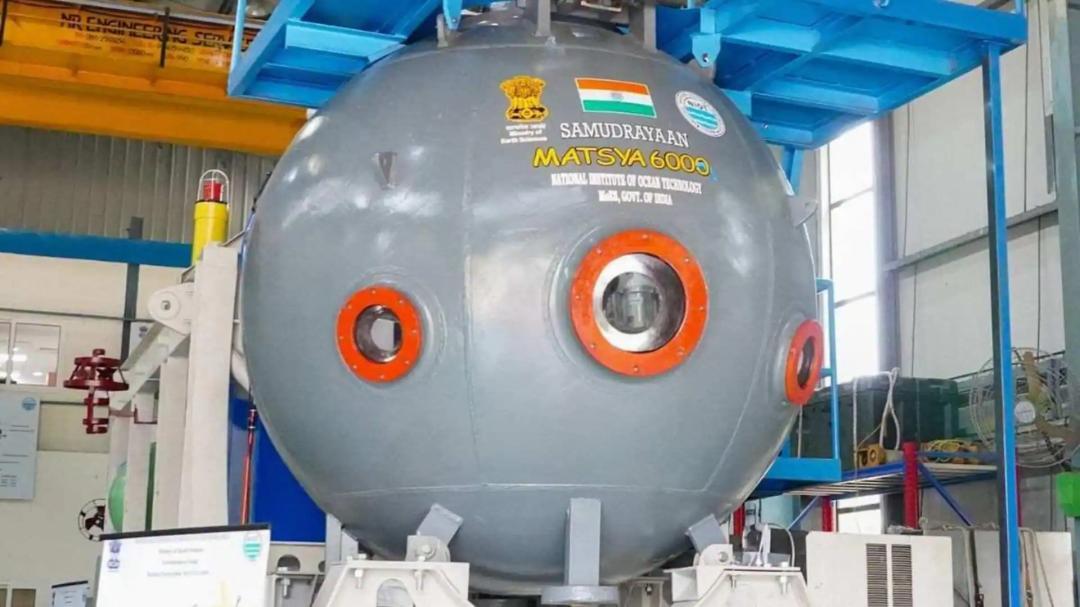
What is causing the delay in India’s Samudrayaan mission?
India’s ambitious Samudrayaan mission, aimed at sending a manned submersible to a depth of 6,000 meters underwater, has hit a roadblock. The mission, led by the National Institute of Ocean Technology (NIOT), has been delayed due to the late delivery of a critical component from France. The syntactic foam cladding, essential for the submersible’s buoyancy, has not arrived on time, pushing back the testing schedule to April next year.
The Samudrayaan mission is a significant undertaking for India, with the objective of exploring the ocean floor, collecting samples, and paving the way for deep-sea mining. The mission is expected to enhance our understanding of the ocean’s ecosystem, identify potential mineral resources, and demonstrate India’s capabilities in deep-sea technologies. However, the delay in the delivery of the syntactic foam cladding has thrown a spanner in the works, and the team is now working to get the mission back on track.
The syntactic foam cladding is a critical component of the submersible, providing the necessary buoyancy to maintain its stability and balance underwater. Without this component, the submersible would be unable to withstand the immense pressure of the deep ocean, making it impossible to achieve the mission’s objectives. The NIOT team had been working tirelessly to assemble the submersible, but the delay in the delivery of the syntactic foam cladding has forced them to put the testing schedule on hold.
The delay is not only a setback for the Samudrayaan mission but also a reminder of the challenges involved in deep-sea exploration. The ocean is a hostile environment, with extreme pressure, temperature, and corrosion conditions that can be detrimental to equipment and human life. The development of deep-sea technologies requires significant investment, expertise, and international collaboration. The Samudrayaan mission is a testament to India’s commitment to advancing its capabilities in this field, but the delay highlights the complexities and risks involved.
The NIOT team is working closely with the French supplier to expedite the delivery of the syntactic foam cladding. The team is also conducting other tests and preparations to ensure that the submersible is ready for deployment as soon as the component arrives. The delay has provided an opportunity for the team to review and refine their plans, ensuring that the mission is executed safely and efficiently.
The Samudrayaan mission is not just about exploring the ocean floor; it also has significant economic and strategic implications. The discovery of new mineral resources, such as copper, zinc, and gold, could provide a significant boost to India’s economy. The mission could also demonstrate India’s capabilities in deep-sea mining, paving the way for future collaborations and investments in this field.
The delay in the Samudrayaan mission is a reminder that deep-sea exploration is a complex and challenging endeavor. However, the NIOT team remains committed to achieving the mission’s objectives and is working tirelessly to overcome the obstacles. The testing schedule is now expected to commence in April next year, and the team is confident that the mission will be a success.
In conclusion, the delay in the Samudrayaan mission is a setback, but it is not a failure. The mission is a significant undertaking that requires careful planning, expertise, and international collaboration. The NIOT team is working to overcome the challenges, and the delay has provided an opportunity to review and refine their plans. The Samudrayaan mission is a testament to India’s commitment to advancing its capabilities in deep-sea technologies, and it is expected to pave the way for future collaborations and investments in this field.
News Source: https://www.newsbytesapp.com/news/science/samudrayaan-mission-delayed-due-to-late-delivery-of-french-foam/story
About the Author