What is causing the delay in India’s Samudrayaan mission?
India’s ambitious Samudrayaan mission, which aims to send a manned submersible to a depth of 6,000 meters underwater, has hit a roadblock. The mission, led by the National Institute of Ocean Technology (NIOT), has been delayed due to the late delivery of a critical component from France. The component in question is syntactic foam cladding, a vital material required for the submersible’s buoyancy. The delay has pushed back the expected testing schedule, with trials now expected to commence by April next year.
The Samudrayaan mission is a significant undertaking for India, with the potential to unlock new avenues for deep-sea exploration, research, and mining. The mission’s primary objective is to design, develop, and demonstrate a manned submersible capable of withstanding the extreme conditions found at depths of up to 6,000 meters. This would enable scientists to collect samples, conduct experiments, and gather valuable data about the ocean floor, which remains one of the most unexplored regions of our planet.
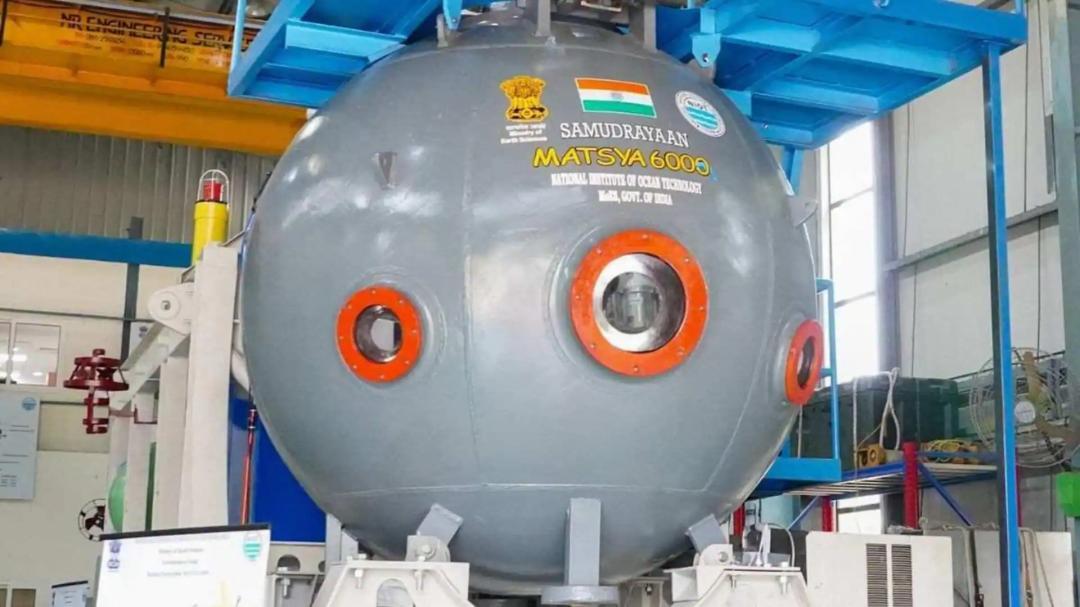
The manned submersible, dubbed the “MATSYA 6000,” is a pressurized vessel designed to maintain a safe internal environment for its occupants, despite the crushing pressure of the deep ocean. The submersible’s buoyancy is critical to its operation, as it needs to be able to descend to great depths and then return to the surface without excessive ballast or propulsion systems. This is where the syntactic foam cladding comes into play.
Syntactic foam is a type of composite material that is both strong and lightweight, making it an ideal choice for applications where buoyancy is essential. The foam is made up of hollow glass microspheres dispersed in a polymer matrix, which provides excellent thermal insulation and resistance to water pressure. In the case of the MATSYA 6000, the syntactic foam cladding is used to provide the necessary buoyancy to counteract the weight of the submersible and its occupants.
The delay in delivering the syntactic foam cladding from France has significant implications for the Samudrayaan mission. The component is not only critical to the submersible’s buoyancy but also requires specialized manufacturing and testing procedures to ensure its reliability and safety. The late delivery has forced the NIOT to revise its testing schedule, with trials now expected to commence by April next year.
While the delay is undoubtedly a setback, it is essential to recognize the complexities and challenges involved in developing a manned submersible capable of operating at such extreme depths. The Samudrayaan mission is a pioneering effort that pushes the boundaries of human knowledge and technological capabilities. The mission’s success will not only enhance our understanding of the ocean floor but also pave the way for future deep-sea exploration and research.
The potential applications of the Samudrayaan mission are vast and varied. Deep-sea mining, for example, could provide access to valuable minerals and resources that are currently unavailable or unexploited. The mission could also enable scientists to study the unique ecosystems found in the deep ocean, which are home to a vast array of species that are still unknown to us. Furthermore, the technological innovations developed as part of the Samudrayaan mission could have spin-off benefits for other industries, such as offshore oil and gas exploration, renewable energy, and marine conservation.
In conclusion, the delay in India’s Samudrayaan mission is a temporary setback, but it highlights the complexities and challenges involved in developing a manned submersible capable of operating at extreme depths. The mission’s success will depend on the timely delivery of critical components, such as the syntactic foam cladding, and the rigorous testing and validation procedures that follow. As we wait for the mission to progress, it is essential to recognize the significance of the Samudrayaan mission and its potential to unlock new avenues for deep-sea exploration, research, and mining.
About the Author