West Antarctic ice melt could weaken ocean carbon absorption
The West Antarctic Ice Sheet has been a subject of concern for scientists and climate experts in recent years, as its melting has been accelerating at an alarming rate. A new study has shed light on the potential consequences of this melting, warning that it could weaken the Southern Ocean’s ability to absorb carbon dioxide. This finding has significant implications for our understanding of the Earth’s climate system and the potential feedback loops that could exacerbate climate change.
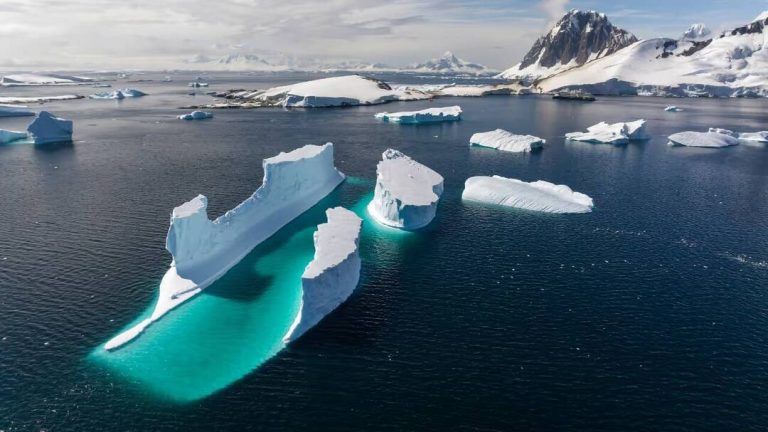
The Southern Ocean, which surrounds Antarctica, plays a crucial role in the global carbon cycle. It absorbs a significant amount of carbon dioxide from the atmosphere, which helps to mitigate the effects of climate change. However, the melting of the West Antarctic Ice Sheet could disrupt this process, leading to a reduction in the ocean’s ability to absorb carbon dioxide. This is because the icebergs that break off from the ice sheet release iron into the ocean, which is an essential nutrient for algae growth.
Algae are a type of phytoplankton that are responsible for absorbing carbon dioxide from the atmosphere through photosynthesis. They then sink to the ocean floor, taking the carbon with them, in a process known as the “biological pump.” This process is an important mechanism for removing carbon dioxide from the atmosphere and storing it in the ocean. However, the iron released by the icebergs is not always usable by the algae, which limits the amount of carbon that can be captured.
The study found that much of the iron released by the icebergs is in a form that is not readily available to the algae. This means that the algae are not able to use the iron to grow and absorb carbon dioxide, which reduces the overall carbon capture potential of the Southern Ocean. This finding has significant implications for our understanding of the Earth’s climate system and the potential consequences of the West Antarctic Ice Sheet’s melting.
The West Antarctic Ice Sheet is considered to be one of the most sensitive regions to climate change. It is situated on a bed of rock that is below sea level, which makes it vulnerable to melting from beneath. As the ocean warms, it can erode the ice sheet from underneath, causing it to melt at an accelerating rate. This process is known as “ice sheet collapse,” and it has the potential to raise global sea levels by several meters.
The study’s findings are based on an analysis of past warming events, which show that the West Antarctic Ice Sheet is highly sensitive to changes in the climate. During these events, the ice sheet melted at a rapid rate, releasing large amounts of iron into the ocean. However, much of this iron was not usable by the algae, which limited the amount of carbon that could be captured.
The implications of this study are significant, as they suggest that the melting of the West Antarctic Ice Sheet could create a feedback loop that makes climate change harder to slow. As the ice sheet melts, it releases iron into the ocean, which could stimulate the growth of algae. However, if the algae are not able to use the iron to absorb carbon dioxide, then the overall carbon capture potential of the Southern Ocean could be reduced. This could lead to an increase in atmospheric carbon dioxide levels, which would exacerbate climate change.
The study’s authors warn that this feedback loop could have significant consequences for the Earth’s climate system. As the West Antarctic Ice Sheet continues to melt, it could release large amounts of iron into the ocean, which could stimulate the growth of algae. However, if the algae are not able to use the iron to absorb carbon dioxide, then the overall carbon capture potential of the Southern Ocean could be reduced. This could lead to an increase in atmospheric carbon dioxide levels, which would exacerbate climate change.
In conclusion, the melting of the West Antarctic Ice Sheet could have significant consequences for the Earth’s climate system. The release of iron into the ocean could stimulate the growth of algae, but if the algae are not able to use the iron to absorb carbon dioxide, then the overall carbon capture potential of the Southern Ocean could be reduced. This could lead to an increase in atmospheric carbon dioxide levels, which would exacerbate climate change. As the world continues to grapple with the challenges of climate change, it is essential that we understand the complex interactions between the Earth’s climate system and the potential feedback loops that could exacerbate the problem.
About the Author