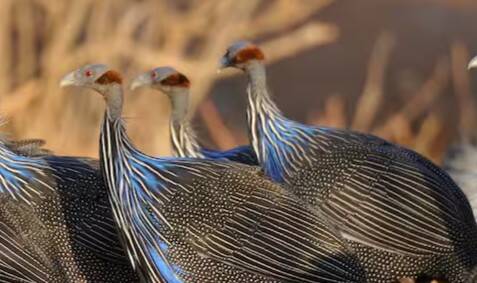
Vulturine Guinea Fowl Uses Light to Look Blue Instead of Pigment
The natural world is full of fascinating phenomena, and the vulturine guinea fowl is a prime example. This bird, found in the open savannas of Africa, has a distinctive electric blue plumage that is both striking and intriguing. But what makes this bird’s feathers so unique is not just their color, but the way they achieve it. Unlike most birds, whose feathers contain pigments that give them their color, the vulturine guinea fowl’s blue feathers contain no pigment at all. So, how do they manage to appear blue? The answer lies in the microscopic structure of their feathers, which scatter light in a way that reflects only blue wavelengths.
This phenomenon is known as structural color, and it’s a remarkable example of evolutionary adaptation. The microscopic structures that give the vulturine guinea fowl its blue color are made up of tiny, branching fibers that reflect light. These fibers are so small that they can only reflect certain wavelengths of light, which is why the bird’s feathers appear blue. This is in contrast to pigment-based colors, which absorb certain wavelengths of light and reflect others. The structural color of the vulturine guinea fowl’s feathers is not just aesthetically pleasing; it also plays a crucial role in the bird’s communication and survival.
In the open savannas where the vulturine guinea fowl lives, visibility is key. The bird’s bright blue feathers help it to stand out against the dull brown and green backdrop of the savanna, making it easier for other birds to see and recognize it. This is particularly important for flock communication, as the vulturine guinea fowl is a social bird that lives in large groups. The blue coloration of its feathers helps to identify individual birds and maintain social bonds within the flock.
But the vulturine guinea fowl’s structural color is not just important for communication; it also plays a role in the bird’s survival. In the open savannas, predators are a constant threat, and the vulturine guinea fowl’s bright blue feathers may help to deter them. The bird’s coloration may also help it to regulate its body temperature, as the structural color of its feathers can reflect or absorb heat as needed.
The study of the vulturine guinea fowl’s structural color is not just of interest to ornithologists and biologists; it’s also inspiring research in optics and materials science. Scientists are fascinated by the way that the bird’s feathers scatter light, and are working to develop new materials and technologies that can mimic this effect. This could have a wide range of applications, from the development of new types of paint and coatings to the creation of more efficient solar cells and optical devices.
One of the key challenges in studying the vulturine guinea fowl’s structural color is understanding the precise mechanisms by which it works. This requires a detailed analysis of the microscopic structure of the bird’s feathers, as well as the way that they interact with light. Scientists are using a range of techniques, including electron microscopy and spectroscopy, to study the bird’s feathers and understand the physics behind its structural color.
As our understanding of the vulturine guinea fowl’s structural color grows, so too do the potential applications of this technology. For example, researchers are exploring the development of new types of display screens that use structural color to produce bright, vivid images. These screens could be more energy-efficient and environmentally friendly than traditional displays, and could have a wide range of applications in fields such as advertising and entertainment.
The vulturine guinea fowl’s structural color is also inspiring research in the field of biomimetics, which involves the development of new materials and technologies that are inspired by nature. By studying the way that the bird’s feathers scatter light, scientists are gaining insights into the fundamental physics of structural color, and are developing new materials and technologies that can mimic this effect.
In conclusion, the vulturine guinea fowl’s use of light to appear blue is a remarkable example of evolutionary adaptation, and is inspiring research in a wide range of fields. From the study of structural color and biomimetics to the development of new materials and technologies, the vulturine guinea fowl is a fascinating bird that is helping us to better understand the natural world and to develop new solutions to real-world problems.
About the Author