Vulturine Guinea Fowl Uses Light to Look Blue Instead of Pigment
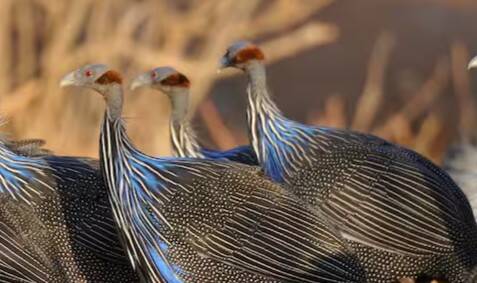
The natural world is full of fascinating examples of how living organisms have evolved to adapt to their environments, and one of the most striking examples of this is the vulturine guinea fowl. This bird, found in the open savannas of Africa, has a truly remarkable appearance, with electric blue feathers that seem to shimmer and glow in the light. But what’s even more remarkable about the vulturine guinea fowl is that its blue feathers don’t contain any pigment at all. Instead, the colour comes from the way that light interacts with the microscopic structure of the feathers themselves.
This phenomenon is known as structural colour, and it’s a key part of what makes the vulturine guinea fowl’s plumage so unique. The microscopic structures that make up the feathers are arranged in such a way that they scatter light, reflecting only the blue wavelengths and giving the appearance of a deep, electric blue. This is in contrast to most other birds, which get their colour from pigments such as melanin or carotenoids. The vulturine guinea fowl’s use of structural colour is a remarkable example of evolutionary adaptation, and it’s a key part of what allows the bird to communicate and survive in its environment.
One of the main ways that the vulturine guinea fowl uses its structural colour is for communication. In the open savannas where the bird lives, it’s essential to be able to signal to other members of the flock, whether it’s to warn them of predators, signal the location of food, or attract a mate. The vulturine guinea fowl’s bright blue feathers are an important part of this communication system, allowing the bird to stand out and convey important information to other members of the flock. The bird’s use of structural colour also helps it to blend in with its surroundings, making it harder for predators to spot it.
But the vulturine guinea fowl’s structural colour is not just important for communication – it’s also a key part of the bird’s survival strategy. In the open savannas, there are many predators that would love to make a meal of a vulturine guinea fowl, from large mammals like lions and leopards to birds of prey like eagles and hawks. The bird’s bright blue feathers help it to distract and confuse these predators, making it harder for them to get a clear shot. The structural colour also helps the bird to regulate its body temperature, reflecting sunlight and keeping it cool in the hot savanna sun.
The vulturine guinea fowl’s use of structural colour is also inspiring research in optics and materials science. Scientists are fascinated by the way that the bird’s feathers are able to scatter light and create such a vivid, electric blue colour, and they’re working to develop new materials and technologies that can mimic this effect. This could have a wide range of applications, from the development of new types of paint and coatings to the creation of more efficient solar cells and other optical devices.
One of the key challenges in studying the vulturine guinea fowl’s structural colour is understanding the precise arrangement of the microscopic structures that make up the feathers. This requires the use of advanced imaging techniques, such as electron microscopy, to get a detailed picture of the feather’s internal structure. Scientists are also using computer simulations to model the way that light interacts with the feathers, allowing them to predict and understand the different ways that the structural colour can be affected by changes in the feather’s structure.
As our understanding of the vulturine guinea fowl’s structural colour continues to grow, it’s likely that we’ll see new and innovative applications of this technology. For example, researchers are already working on developing new types of camouflage materials that can mimic the bird’s ability to blend in with its surroundings. This could have a wide range of applications, from military uniforms to medical devices. The study of the vulturine guinea fowl’s structural colour is also inspiring new approaches to the development of sustainable materials and technologies, such as more efficient solar cells and bio-inspired coatings.
In conclusion, the vulturine guinea fowl’s use of light to look blue instead of pigment is a truly remarkable example of evolutionary adaptation. The bird’s structural colour is a key part of its communication and survival strategy, and it’s inspiring research in optics and materials science. As we continue to learn more about the vulturine guinea fowl and its unique characteristics, it’s likely that we’ll see new and innovative applications of this technology. Whether it’s in the development of new materials, the creation of more efficient solar cells, or the inspiration of new approaches to sustainable design, the vulturine guinea fowl’s structural colour is a truly remarkable phenomenon that’s worth learning more about.
About the Author