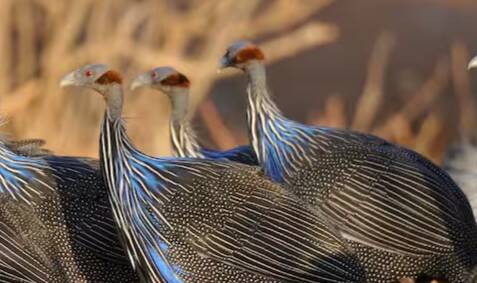
Vulturine Guinea Fowl Uses Light to Look Blue Instead of Pigment
The natural world is full of fascinating examples of how animals have adapted to their environments, often in ways that seem almost magical. One such example is the vulturine guinea fowl, a bird found in the open savannas of Africa. At first glance, the vulturine guinea fowl’s electric blue feathers seem like a striking example of pigmentation, but scientists have discovered that the colour comes from a more unexpected source: the microscopic structure of the feathers themselves.
Research has shown that the vulturine guinea fowl’s blue feathers contain no pigment at all. Instead, the colour is created by the way that light interacts with the microscopic structure of the feathers. This phenomenon is known as structural colour, and it’s a key part of what makes the vulturine guinea fowl’s plumage so striking.
So, how does it work? The feathers of the vulturine guinea fowl are made up of tiny, branching structures that reflect light. These structures are so small that they’re measured in nanometers, and they’re arranged in a specific pattern that scatters light in a way that favours the reflection of blue wavelengths. This means that when light hits the feathers, the blue wavelengths are reflected back to our eyes, giving the appearance of a vibrant, electric blue colour.
This use of structural colour is not unique to the vulturine guinea fowl, of course. Many animals use similar techniques to create colour and texture, from the shimmering scales of fish to the iridescent wings of butterflies. However, the vulturine guinea fowl’s use of structural colour is particularly striking, and it’s a key part of what makes the bird so well adapted to its environment.
In the open savannas where the vulturine guinea fowl lives, communication and survival are crucial. The bird’s bright blue feathers play a key role in both of these areas, helping the bird to stand out and signal to other members of its flock. This is particularly important in the savannas, where predators are common and the ability to communicate quickly and effectively can be the difference between life and death.
But the vulturine guinea fowl’s structural colour is not just interesting from a biological perspective. It’s also inspiring research in optics and materials science, where scientists are working to develop new materials and technologies that can mimic the bird’s remarkable ability to create colour from structure.
One potential application of this research is in the development of new types of display screens. By using microscopic structures to create colour, it may be possible to develop screens that are more efficient and more vibrant than traditional LCD or LED displays. This could have a major impact on the tech industry, where the demand for high-quality displays is constantly growing.
Another potential application is in the field of biomedical research, where scientists are working to develop new types of implantable devices that can be used to monitor and treat a range of medical conditions. By using structural colour to create tiny, implantable sensors that can detect changes in the body, it may be possible to develop new treatments for conditions such as diabetes and heart disease.
In conclusion, the vulturine guinea fowl’s use of light to look blue instead of pigment is a fascinating example of the natural world’s ability to inspire and amaze us. From the bird’s remarkable adaptations to its environment, to the potential applications of its structural colour in fields such as optics and materials science, the vulturine guinea fowl is a true marvel of nature.
Whether you’re a biologist, a materials scientist, or simply someone who appreciates the beauty of the natural world, the vulturine guinea fowl is definitely worth learning more about. And who knows? The bird’s remarkable ability to create colour from structure may one day inspire a whole new generation of technologies and innovations.
About the Author