Vulturine Guinea Fowl Uses Light to Look Blue Instead of Pigment
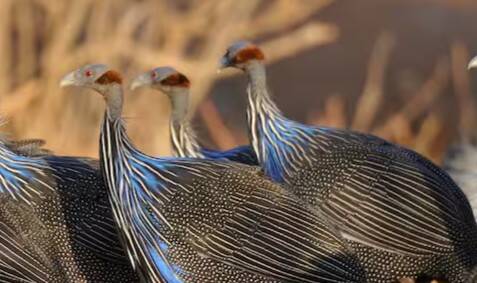
The natural world is full of fascinating examples of how animals have evolved to survive and thrive in their environments. One such example is the vulturine guinea fowl, a bird species found in the savannas of East Africa. What makes this bird particularly interesting is its striking electric blue feathers, which are not just a result of pigmentation, but rather a remarkable example of how light can be used to create color.
At first glance, the vulturine guinea fowl’s blue feathers appear to be the result of pigmentation, similar to how humans have melanin in their skin to give it color. However, scientists have discovered that the bird’s feathers contain no pigment at all. So, how does it achieve its bright blue color? The answer lies in the microscopic structure of the feathers themselves.
Research has shown that the feathers of the vulturine guinea fowl have a unique structure that allows them to scatter light in a way that reflects only blue wavelengths. This phenomenon is known as structural coloration, where the physical structure of a material determines its color, rather than the presence of pigments. In the case of the vulturine guinea fowl, the microscopic structure of its feathers is made up of tiny, crystal-like formations that refract and reflect light, giving the appearance of a bright blue color.
But why is this important? For the vulturine guinea fowl, its striking blue feathers play a crucial role in communication and survival. In the open savannas where the bird lives, its bright blue coloration helps it to stand out and communicate with other members of its flock. This is particularly important for a bird that lives in a harsh environment, where predators are abundant and food is scarce. By being able to communicate effectively with its flock, the vulturine guinea fowl can increase its chances of survival and success.
The vulturine guinea fowl’s use of structural coloration is not just limited to its feathers. The bird’s skin and beak also exhibit this phenomenon, giving it an overall blue-gray appearance. This is in contrast to other bird species, which often rely on pigmentation to achieve their colors. The unique structure of the vulturine guinea fowl’s feathers and skin makes it one of the most striking examples of structural coloration in the natural world.
The discovery of the vulturine guinea fowl’s use of structural coloration has also inspired research in optics and materials science. Scientists are interested in understanding how the bird’s feathers are able to scatter light in such a way that reflects only blue wavelengths. This knowledge could potentially be used to develop new materials and technologies that can mimic the bird’s structural coloration.
For example, researchers are exploring the possibility of creating new types of optical materials that can be used in a variety of applications, from cosmetics to telecommunications. By studying the structure of the vulturine guinea fowl’s feathers, scientists may be able to develop new materials that can scatter light in a similar way, creating a range of new colors and effects.
In addition to its potential applications in materials science, the study of the vulturine guinea fowl’s structural coloration is also providing insights into the evolution of bird coloration. Scientists are interested in understanding how the bird’s unique feather structure evolved, and what advantages it provides in terms of communication and survival.
Overall, the vulturine guinea fowl’s use of light to look blue instead of pigment is a fascinating example of the natural world’s ability to inspire and surprise us. By studying this remarkable bird, scientists are gaining a deeper understanding of the complex relationships between light, matter, and color, and are developing new technologies and materials that could have a wide range of applications.
In conclusion, the vulturine guinea fowl’s electric blue feathers are a remarkable example of how light can be used to create color, and are an important part of the bird’s communication and survival strategies. As scientists continue to study this fascinating bird, they are gaining a deeper understanding of the complex relationships between light, matter, and color, and are developing new technologies and materials that could have a wide range of applications.
About the Author