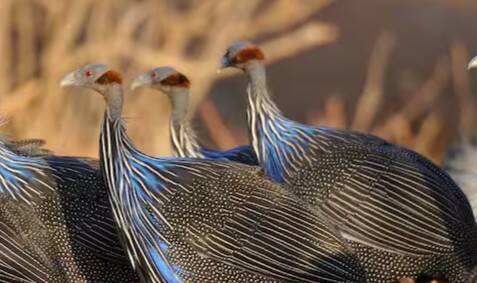
Vulturine Guinea Fowl Uses Light to Look Blue Instead of Pigment
The natural world is full of fascinating creatures, each with unique characteristics that enable them to thrive in their environments. One such bird that has garnered significant attention from scientists and bird enthusiasts alike is the vulturine guinea fowl. This striking bird, found in the savannas of East Africa, boasts electric blue feathers that are not just a treat to the eyes but also a subject of scientific interest. What’s remarkable about the vulturine guinea fowl’s blue plumage is that it doesn’t contain any pigment. So, how does it achieve this vibrant color? The answer lies in the microscopic structure of its feathers, which scatter light in a way that reflects only blue wavelengths.
To understand this phenomenon, let’s dive into the world of structural coloration. Structural coloration refers to the production of color through the interaction of light with microscopic structures, rather than through the presence of pigments. This is in contrast to pigmentary coloration, where colors are produced by the absorption and reflection of light by pigments. In the case of the vulturine guinea fowl, the blue coloration is a result of the way the microscopic structure of its feathers scatters light.
The feathers of the vulturine guinea fowl contain tiny, crystal-like structures that refract light. When light hits these structures, it is scattered in all directions, but the blue wavelengths are reflected back to our eyes, giving the appearance of blue color. This process is known as Rayleigh scattering, named after the British physicist Lord Rayleigh, who first described it in the late 19th century. Rayleigh scattering is responsible for the blue color of the sky and is also seen in other natural phenomena, such as the blue color of certain types of opals.
The vulturine guinea fowl’s use of structural coloration has several advantages. For one, it allows the bird to produce a bright, vibrant color without the need for pigments, which can be energetically expensive to produce. Additionally, the structural coloration of the vulturine guinea fowl’s feathers is incredibly durable and resistant to fading, as it is not dependent on the presence of pigments that can degrade over time.
But the vulturine guinea fowl’s blue feathers are not just a striking feature; they also play a crucial role in the bird’s survival and communication. In the open savannas where the vulturine guinea fowl lives, the ability to communicate with other members of its flock is essential. The bird’s bright blue feathers serve as a visual signal, allowing it to convey information to other birds about its identity, status, and intentions. The blue coloration may also help the vulturine guinea fowl to attract mates or deter rivals, as is the case with many other bird species.
The study of the vulturine guinea fowl’s structural coloration has also inspired research in optics and materials science. Scientists are interested in understanding the microscopic structures that produce the bird’s blue coloration, with the goal of developing new materials that can mimic this effect. Such materials could have a wide range of applications, from the development of more efficient solar cells to the creation of new types of display screens.
In addition, the study of structural coloration in birds like the vulturine guinea fowl has the potential to inform the development of new technologies for producing color. Currently, most color-producing technologies rely on the use of pigments, which can be limited in their range and durability. By understanding how birds like the vulturine guinea fowl produce color through structural means, scientists may be able to develop new, more sustainable methods for producing color that do not rely on pigments.
In conclusion, the vulturine guinea fowl’s use of light to produce its electric blue feathers is a fascinating example of the natural world’s ability to inspire scientific inquiry and innovation. Through the study of this bird’s unique characteristics, scientists are gaining a deeper understanding of the physics of structural coloration and its potential applications in fields like optics and materials science. As we continue to explore and learn from the natural world, we may uncover even more surprising and innovative solutions to the challenges we face.
About the Author