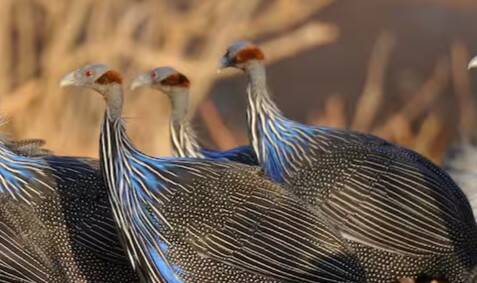
Vulturine Guinea Fowl Uses Light to Look Blue Instead of Pigment
The natural world is full of fascinating creatures, each with unique characteristics that have evolved to help them survive and thrive in their environments. One such creature is the vulturine guinea fowl, a bird known for its striking electric blue feathers. However, what makes this bird truly remarkable is not just the color of its feathers, but how it achieves that color. Unlike most other birds, the vulturine guinea fowl’s electric blue feathers contain no pigment. Instead, the color comes from microscopic feather structures that scatter light, reflecting only blue wavelengths.
This phenomenon is known as structural color, and it’s a common occurrence in nature. Structural color is created when microscopic structures, such as tiny scales or platelets, interact with light to produce specific colors. In the case of the vulturine guinea fowl, the microscopic structures in its feathers are made up of tiny, flat platelets called melanosomes. These melanosomes are arranged in a specific pattern to scatter light and reflect only blue wavelengths, giving the feathers their distinctive electric blue color.
But why is this important? For the vulturine guinea fowl, its electric blue feathers play a crucial role in communication and survival. In the open savannas where the bird lives, its bright blue feathers help it to stand out and signal to other members of its flock. This is particularly important for a bird that lives in a group, as it helps to maintain social bonds and warn other birds of potential predators.
The vulturine guinea fowl’s use of structural color is also an important adaptation for its environment. In the savannas, the sun can be intense, and the bird’s blue feathers help to reflect some of that sunlight and keep it cool. Additionally, the bird’s feathers may help to confuse or distract predators, giving it an advantage in terms of survival.
The study of the vulturine guinea fowl’s structural color is not just interesting from a biological perspective, but also from a materials science perspective. The unique properties of the bird’s feathers have inspired researchers to develop new materials that can mimic the same effects. For example, scientists are working on creating materials that can scatter light in specific ways to produce certain colors, without the need for pigments.
This research has the potential to lead to a wide range of applications, from the development of more efficient solar cells to the creation of new types of displays and screens. The study of structural color in nature can also help us to better understand the properties of light and how it interacts with different materials.
In addition to its potential applications, the study of the vulturine guinea fowl’s structural color is also an important reminder of the importance of basic scientific research. By studying the natural world and the unique characteristics of different creatures, we can gain a deeper understanding of the world around us and develop new technologies and materials that can improve our lives.
In conclusion, the vulturine guinea fowl’s electric blue feathers are a remarkable example of the unique adaptations that can be found in nature. The bird’s use of structural color to produce its distinctive blue color is not only an important aspect of its communication and survival, but also an inspiration for research in optics and materials science. As we continue to study the natural world and the creatures that inhabit it, we may uncover even more surprising and fascinating examples of how animals use light and color to their advantage.
The vulturine guinea fowl’s use of light to look blue instead of pigment is a testament to the incredible diversity and complexity of the natural world. As we learn more about this remarkable bird and its unique characteristics, we are reminded of the importance of preserving and protecting the natural world, and the many wonders that it contains.
About the Author