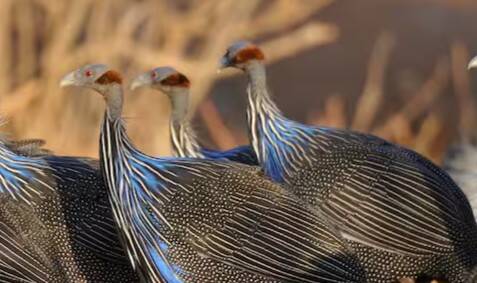
Vulturine Guinea Fowl Uses Light to Look Blue Instead of Pigment
The natural world is full of fascinating phenomena, and one of the most striking examples is the vulturine guinea fowl’s electric blue feathers. These birds, found in the open savannas of East Africa, have a unique appearance that has long been a subject of interest among scientists and bird enthusiasts alike. Recent studies have revealed that the vulturine guinea fowl’s blue feathers contain no pigment, and instead, the color is produced by the microscopic structure of the feathers themselves. This remarkable discovery has shed new light on the biology of these birds and has also inspired research in optics and materials science.
The vulturine guinea fowl’s blue feathers are a result of a phenomenon known as structural coloration. This means that the color is not produced by pigments, but rather by the way that light interacts with the microscopic structure of the feathers. The feathers contain tiny, plate-like structures called melanosomes, which are made up of the protein melanin. These melanosomes are arranged in a specific way to scatter light, reflecting only the blue wavelengths and giving the feathers their characteristic color.
The use of structural coloration by the vulturine guinea fowl is not unique, as many other birds and animals also use this method to produce color. However, the vulturine guinea fowl’s blue feathers are particularly striking, and scientists have been keen to understand the mechanisms behind this phenomenon. By studying the microscopic structure of the feathers, researchers have been able to gain a deeper understanding of how the color is produced and how it is used by the birds.
One of the most interesting aspects of the vulturine guinea fowl’s blue feathers is the way that they are used for communication and survival. In the open savannas, the birds need to be able to communicate with each other over long distances, and the blue feathers play a crucial role in this process. The bright blue color is highly visible, even at a distance, and it allows the birds to signal to each other about potential threats or food sources. The feathers are also used in courtship displays, where the males will show off their bright blue plumage to attract females.
The study of the vulturine guinea fowl’s blue feathers has also inspired research in optics and materials science. Scientists are interested in understanding how the microscopic structure of the feathers produces the blue color, and how this can be replicated in other materials. This research has the potential to lead to the development of new materials with unique optical properties, such as self-cleaning surfaces or more efficient solar cells.
The use of structural coloration by the vulturine guinea fowl is also an example of the amazing adaptability of nature. The birds have evolved to use the microscopic structure of their feathers to produce a bright blue color, rather than relying on pigments. This is a testament to the incredible diversity of life on Earth and the many different ways that organisms have evolved to survive and thrive in their environments.
In conclusion, the vulturine guinea fowl’s electric blue feathers are a fascinating example of the natural world’s ability to produce striking colors without the use of pigments. The microscopic structure of the feathers, which scatters light to reflect only blue wavelengths, is a remarkable phenomenon that has inspired research in optics and materials science. The use of structural coloration by the vulturine guinea fowl is also an important part of their communication and survival strategies, and it is a testament to the amazing adaptability of nature.
As scientists continue to study the vulturine guinea fowl and its unique feathers, we can expect to learn more about the biology of these birds and the ways in which they interact with their environment. We may also see the development of new materials and technologies that are inspired by the microscopic structure of the feathers. For now, the vulturine guinea fowl remains a fascinating example of the natural world’s ability to produce beauty and complexity without the use of pigments.
About the Author