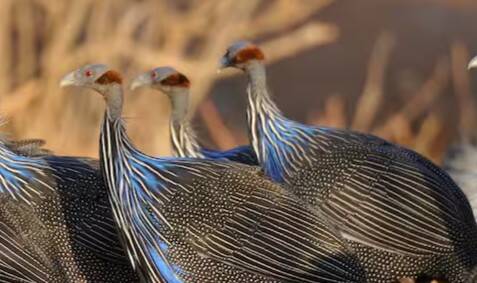
Vulturine Guinea Fowl Uses Light to Look Blue Instead of Pigment
The natural world is full of fascinating creatures, each with unique characteristics that have evolved to help them survive and thrive in their environments. One such creature is the vulturine guinea fowl, a bird found in the savannas of East Africa. This bird is known for its striking electric blue feathers, which are not only visually stunning but also play a crucial role in the bird’s communication and survival. What’s remarkable about the vulturine guinea fowl’s blue feathers is that they don’t contain any pigment. Instead, the colour is created by microscopic structures within the feathers that scatter light, reflecting only blue wavelengths.
The vulturine guinea fowl’s use of light to create its blue colour is a phenomenon known as structural colour. This is different from pigment-based colour, where the colour is created by the absorption and reflection of light by molecules. Structural colour, on the other hand, is created by the way that light interacts with the microscopic structure of a material. In the case of the vulturine guinea fowl’s feathers, the microscopic structure is made up of tiny, crystal-like formations that reflect light in a way that creates the blue colour.
The use of structural colour by the vulturine guinea fowl has several advantages. For one, it allows the bird to create a bright, vibrant colour without the need for pigments, which can be costly to produce and maintain. It also provides the bird with a way to communicate with other members of its flock, as the blue colour can be used to signal aggression, courtship, or other social behaviors. In addition, the blue colour may help the bird to blend in with its surroundings, making it less visible to predators.
The vulturine guinea fowl’s use of structural colour is not unique in the natural world. Many other creatures, including butterflies, peacocks, and birds, use similar mechanisms to create their colours. However, the vulturine guinea fowl’s use of structural colour is particularly interesting because of the way that it creates its blue colour. The bird’s feathers contain tiny, plate-like structures that reflect light in a way that creates the blue colour. These structures are made up of a protein called melanin, which is also found in human hair and skin.
The study of the vulturine guinea fowl’s structural colour is not only interesting from a biological perspective, but it also has potential applications in fields such as optics and materials science. Researchers are studying the microscopic structures that create the bird’s blue colour, with the goal of developing new materials that can mimic this effect. Such materials could have a wide range of applications, from creating more efficient solar cells to developing new types of displays and sensors.
In addition to its potential applications in technology, the study of the vulturine guinea fowl’s structural colour is also providing insights into the evolution of colour in the natural world. By studying the way that the bird’s feathers create their blue colour, researchers are gaining a better understanding of the mechanisms that underlie the creation of colour in other creatures. This knowledge can be used to inform the development of new materials and technologies, as well as to better understand the complex interactions between light, matter, and colour.
The vulturine guinea fowl is a remarkable creature, with its striking electric blue feathers and fascinating use of structural colour. The study of this bird is providing insights into the natural world, as well as inspiring new technologies and materials. As researchers continue to study the vulturine guinea fowl and its unique colouration, we can expect to learn more about the intricate mechanisms that underlie the creation of colour in the natural world.
In conclusion, the vulturine guinea fowl’s use of light to create its blue colour is a fascinating phenomenon that is providing insights into the natural world and inspiring new technologies. The bird’s structural colour is a remarkable example of the complex interactions between light, matter, and colour, and it is a reminder of the incredible diversity and complexity of the natural world. As we continue to study the vulturine guinea fowl and its unique colouration, we can expect to learn more about the intricate mechanisms that underlie the creation of colour in the natural world.
About the Author