Vulturine Guinea Fowl Uses Light to Look Blue Instead of Pigment
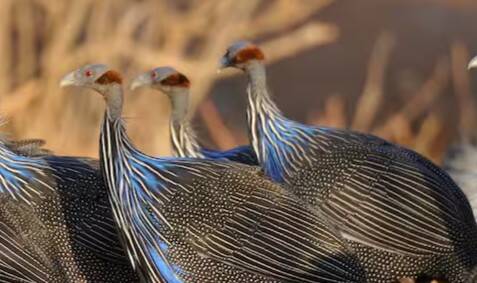
The natural world is full of fascinating creatures, each with unique characteristics that set them apart from others. One such bird that has caught the attention of scientists is the vulturine guinea fowl, known for its striking electric blue feathers. What’s remarkable about this bird is that its blue feathers contain no pigment, a fact that has left many wondering how it achieves its vibrant color. Recent studies have revealed that the vulturine guinea fowl’s blue coloration is not due to pigmentation, but rather the result of microscopic feather structures that scatter light, reflecting only blue wavelengths.
To understand how this works, let’s delve into the world of structural color, a phenomenon where the physical structure of a material or object determines its color. Unlike pigment-based colors, which absorb certain wavelengths of light and reflect others, structural colors rely on the way light interacts with the microscopic structure of the material. In the case of the vulturine guinea fowl, its feathers contain tiny, crystal-like structures that refract and reflect light in a specific way, giving the appearance of blue coloration.
The study of structural color in the vulturine guinea fowl has significant implications for our understanding of optics and materials science. By examining the microscopic structures responsible for the bird’s blue color, scientists can gain insights into the properties of light and how it interacts with different materials. This knowledge can be applied to the development of new materials and technologies, such as more efficient solar cells or advanced optical devices.
But the vulturine guinea fowl’s blue feathers are not just a curiosity; they also play a crucial role in the bird’s survival and communication. In the open savannas where the vulturine guinea fowl lives, its bright blue coloration serves as a visual signal to other members of its flock. This helps the birds to recognize one another and maintain social bonds, which are essential for their survival in a harsh and competitive environment.
In addition to its role in communication, the vulturine guinea fowl’s blue coloration may also provide camouflage in certain situations. While the bird’s bright blue feathers may seem conspicuous, they can also help it to blend in with the surrounding environment. In the savannas, the blue coloration can be similar to the color of the sky or distant hills, making it more difficult for predators to spot the bird.
The study of the vulturine guinea fowl’s structural color has also inspired research in other fields, such as biology and ecology. By examining the evolution of structural color in different species, scientists can gain insights into the selective pressures that have shaped the development of these remarkable traits. This can help us to better understand the complex relationships between organisms and their environments, and how these interactions have driven the evolution of diverse characteristics.
In conclusion, the vulturine guinea fowl’s use of light to achieve its blue coloration is a fascinating example of the complex and often surprising ways in which nature works. Through the study of structural color, scientists can gain a deeper understanding of the natural world and develop new technologies and materials inspired by the remarkable characteristics of living organisms. As we continue to explore and learn from the natural world, we may uncover even more surprising secrets about the intricate and beautiful ways in which life on Earth has evolved.
About the Author