Vulturine Guinea Fowl Uses Light to Look Blue Instead of Pigment
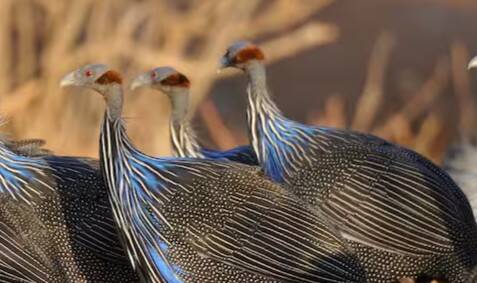
The natural world is full of fascinating creatures, each with unique characteristics that have evolved to help them survive and thrive in their environments. One such creature is the vulturine guinea fowl, a bird known for its striking electric blue feathers. However, what makes these feathers truly remarkable is not the presence of a specific pigment, but rather the way they interact with light. Scientists have discovered that the vulturine guinea fowl’s blue coloration is not due to the presence of a blue pigment, but rather the result of microscopic feather structures that scatter light, reflecting only blue wavelengths.
This phenomenon is known as structural coloration, where the physical structure of a material, in this case, the feathers, determines its color. The microscopic structures in the feathers of the vulturine guinea fowl are made up of tiny, flat platelets called melanosomes, which are arranged in a specific pattern to create the blue color. When light hits these platelets, it is scattered in all directions, but the blue wavelengths are reflected back to our eyes, giving the appearance of a bright blue color.
The use of structural coloration by the vulturine guinea fowl is not just a matter of aesthetics; it also plays a crucial role in the bird’s survival and communication. In the open savannas where the vulturine guinea fowl lives, the blue coloration serves as a visual signal to other members of the flock, helping to maintain social bonds and coordinate behavior. The bright blue feathers may also serve as a warning to potential predators, signaling that the bird is a member of a large and vigilant flock.
The discovery of the vulturine guinea fowl’s structural coloration has significant implications for our understanding of the evolution of coloration in birds. It suggests that the use of structural coloration may be more widespread than previously thought, and that it may have played a key role in the development of complex social behaviors in birds. Furthermore, the study of structural coloration in the vulturine guinea fowl has inspired research in optics and materials science, as scientists seek to develop new materials that can mimic the bird’s remarkable ability to manipulate light.
One potential application of this research is in the development of new display technologies, such as ultra-high definition screens and optical fibers. By studying the microscopic structures that create the vulturine guinea fowl’s blue color, scientists may be able to develop new materials that can produce similar effects, leading to more efficient and effective displays. Additionally, the study of structural coloration in the vulturine guinea fowl may also lead to the development of new biomimetic materials, such as self-cleaning surfaces and optical coatings.
In conclusion, the vulturine guinea fowl’s use of light to create its striking blue color is a remarkable example of the natural world’s ability to inspire and inform scientific research. The study of structural coloration in this bird has opened up new avenues of research in optics and materials science, and has significant implications for our understanding of the evolution of coloration in birds. As we continue to learn more about the natural world, we are constantly reminded of the incredible complexity and beauty of the world around us, and the many secrets that remain to be uncovered.
The vulturine guinea fowl’s blue feathers are a testament to the incredible diversity of life on Earth, and the many ways in which living organisms have evolved to interact with their environments. As we continue to explore and learn more about the natural world, we are constantly inspired by the intricate and complex relationships between living organisms and their environments. The study of the vulturine guinea fowl’s structural coloration is just one example of the many fascinating stories that remain to be told about the natural world, and the many secrets that remain to be uncovered.
About the Author