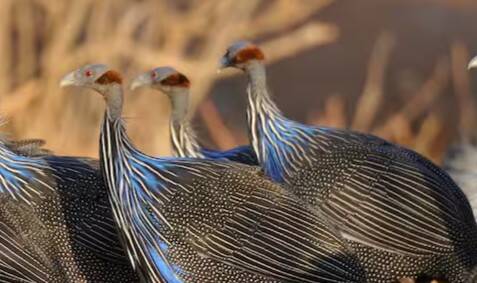
Vulturine Guinea Fowl Uses Light to Look Blue Instead of Pigment
In the vast and diverse world of birds, there exist numerous species that have evolved to exhibit stunning visual displays, often serving purposes beyond mere aesthetics. Among these, the vulturine guinea fowl stands out for its striking electric blue feathers. What’s fascinating about this bird, however, isn’t just the vibrant coloration of its plumage but the novel way it achieves this color. Unlike most birds and animals, which rely on pigments to display color, the vulturine guinea fowl uses a completely different mechanism: it utilizes light itself to appear blue.
The electric blue color of the vulturine guinea fowl’s feathers is not due to the presence of any blue pigment. Instead, scientists have discovered that the color is a result of microscopic structures within the feathers that scatter light in such a way that they reflect only the blue wavelengths. This phenomenon is known as structural coloration, where the physical structure of the material (in this case, the microscopic structure of the feathers) determines its color, rather than chemical pigments.
Structural coloration is not unique to the vulturine guinea fowl; it can be observed in various forms across nature, from the iridescence of butterfly wings to the shimmering colors of peacock feathers. However, the specific mechanism by which the vulturine guinea fowl achieves its blue color is particularly noteworthy for its simplicity and effectiveness. The microscopic structures responsible for this effect are tiny, intricately arranged melanosomes (the organelles that contain melanin, the pigment responsible for skin and hair color in humans) within the feathers. These melanosomes are arranged in such a precise manner that they scatter shorter (blue) wavelengths of light more than longer (red) wavelengths, giving the feathers their characteristic blue appearance.
The striking blue plumage of the vulturine guinea fowl serves more than just an aesthetic purpose. In the open savannas where these birds live, their electric blue feathers play a critical role in communication and survival. The bright coloration can help individuals recognize one another, facilitating social interactions within the flock. Moreover, the vibrant feathers may also serve as a signal of health and vigor, potentially influencing mate choice and social status within the group.
Beyond its importance to the bird itself, the vulturine guinea fowl’s unique use of structural coloration has significant implications for human fields of study, particularly in optics and materials science. The precise arrangement of microscopic structures to achieve specific optical effects is of great interest to scientists and engineers, who see potential applications in the development of new materials and technologies. For instance, understanding how the vulturine guinea fowl’s feathers scatter light could inspire the creation of more efficient optical materials, such as those used in displays, sensors, or even more efficient solar cells.
The study of structural coloration in nature also highlights the ingenuity and diversity of evolutionary solutions. By examining how different organisms achieve specific optical effects, researchers can gain insights into the fundamental principles of light interaction with matter at the microscopic scale. This knowledge can then be applied to develop novel materials and technologies that mimic or improve upon nature’s designs.
In conclusion, the vulturine guinea fowl’s use of light to appear blue, rather than relying on pigment, is a testament to the incredible diversity and ingenuity of natural solutions. The bird’s electric blue feathers, achieved through the precise arrangement of microscopic structures, not only serve important functions for the bird’s survival and social interactions but also offer a fascinating model for scientific study and technological innovation. As we continue to explore and understand the intricacies of nature, we may uncover even more remarkable examples of how organisms utilize light and structure to create their often breathtaking visual displays.
About the Author