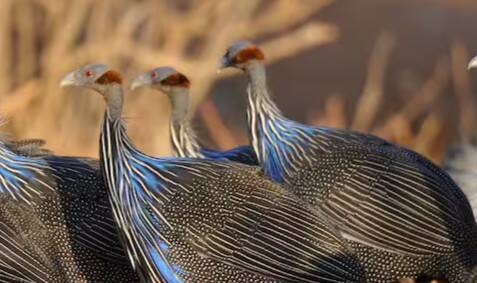
Vulturine Guinea Fowl Uses Light to Look Blue Instead of Pigment
The natural world is full of fascinating examples of how living organisms have evolved to adapt to their environments. One such example is the vulturine guinea fowl, a bird species found in the savannas of East Africa. This bird is known for its striking electric blue feathers, which are not just a product of pigmentation, but rather a result of a unique structural arrangement of microscopic feather structures that scatter light. In this blog post, we will delve into the science behind the vulturine guinea fowl’s blue feathers and explore how this phenomenon is inspiring research in optics and materials science.
The vulturine guinea fowl’s electric blue feathers are a sight to behold. At first glance, it may seem that the color is a result of pigmentation, just like the colors of other birds. However, scientists have discovered that the feathers of the vulturine guinea fowl contain no pigment. Instead, the color is a result of the way that light interacts with the microscopic structure of the feathers. The feathers are made up of tiny, branching filaments that reflect light and scatter it in all directions. This scattering effect is what gives the feathers their blue color, as the shorter wavelengths of light (such as blue and violet) are scattered more than the longer wavelengths (such as red and orange).
This phenomenon is known as structural coloration, and it is a common feature of many living organisms. Structural coloration occurs when the microscopic structure of a material interacts with light in a way that produces color. This can happen through a variety of mechanisms, including scattering, diffraction, and interference. In the case of the vulturine guinea fowl, the structural coloration is a result of the scattering of light by the tiny filaments that make up the feathers.
The vulturine guinea fowl’s blue feathers are not just a pretty sight; they also play an important role in the bird’s communication and survival. In the open savannas where the bird lives, the blue coloration helps the vulturine guinea fowl to stand out against the dull brown and green background. This makes it easier for the birds to communicate with each other, as they can see each other’s blue feathers from a distance. The blue coloration may also serve as a warning signal to potential predators, as it makes the bird more visible and may deter predators from attacking.
The study of the vulturine guinea fowl’s structural coloration is not just of interest to ornithologists and biologists; it is also inspiring research in optics and materials science. Scientists are interested in understanding the mechanisms behind structural coloration, as it has the potential to be used in a wide range of applications. For example, materials with structural coloration could be used to create more efficient solar cells, or to develop new types of displays and sensors.
One of the key challenges in studying structural coloration is understanding the relationship between the microscopic structure of a material and the way that it interacts with light. This requires the use of advanced imaging and simulation techniques, such as electron microscopy and computational modeling. By using these techniques, scientists can gain a detailed understanding of the mechanisms behind structural coloration, and can begin to develop new materials and technologies that exploit these effects.
In addition to its potential applications in optics and materials science, the study of structural coloration is also inspiring new areas of research in biology and ecology. For example, scientists are interested in understanding how structural coloration evolves in different species, and how it is used in different contexts. This requires a multidisciplinary approach, combining techniques from biology, physics, and materials science to understand the complex interactions between living organisms and their environments.
In conclusion, the vulturine guinea fowl’s electric blue feathers are a remarkable example of the complex and fascinating ways in which living organisms interact with their environments. The study of structural coloration is a rapidly evolving field, with potential applications in optics, materials science, biology, and ecology. As scientists continue to explore the mechanisms behind structural coloration, they are gaining a deeper understanding of the intricate relationships between living organisms and their environments, and are developing new technologies and materials that exploit these effects.
About the Author