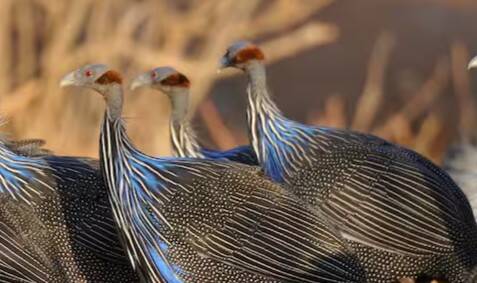
Vulturine Guinea Fowl Uses Light to Look Blue Instead of Pigment
The natural world is full of fascinating phenomena, and the vulturine guinea fowl is a prime example of this. This bird, native to the savannas of East Africa, has a striking electric blue plumage that is both beautiful and functional. But what’s truly remarkable about the vulturine guinea fowl’s feathers is that they contain no pigment. Instead, the bird’s blue coloration comes from microscopic feather structures that scatter light, reflecting only blue wavelengths.
This phenomenon is known as structural coloration, and it’s a key component of the vulturine guinea fowl’s unique appearance. The bird’s feathers are made up of tiny, branching structures that refract and reflect light, giving the appearance of blue coloration. This is in contrast to pigment-based coloration, where the color is derived from the presence of specific chemicals or pigments. In the case of the vulturine guinea fowl, the blue color is created by the physical structure of the feathers themselves, rather than any specific pigment.
So, why is this important? For one, the vulturine guinea fowl’s structural coloration plays a crucial role in its communication and survival. In the open savannas where the bird lives, the ability to stand out and be seen is essential for finding food, avoiding predators, and attracting mates. The bird’s bright blue feathers serve as a visual signal, allowing it to communicate with other members of its flock and establish its place within the social hierarchy.
But the vulturine guinea fowl’s structural coloration is not just important for the bird itself – it’s also inspiring research in optics and materials science. Scientists are fascinated by the way that the bird’s feathers interact with light, and are working to develop new materials and technologies that mimic this effect. This could have a wide range of applications, from the development of more efficient solar cells to the creation of new types of display screens.
One of the key challenges in studying the vulturine guinea fowl’s structural coloration is understanding the precise mechanisms by which it works. This requires a combination of advanced imaging techniques, such as electron microscopy, and sophisticated computational models. By studying the microscopic structure of the bird’s feathers and simulating the way that light interacts with them, scientists can gain a deeper understanding of the underlying physics and develop new materials that exhibit similar properties.
In addition to its potential applications in technology, the vulturine guinea fowl’s structural coloration is also an important area of study in the field of biology. By understanding how the bird’s feathers produce their unique coloration, scientists can gain insights into the evolution of coloration in other animals, and how it is used for communication and mating. This can also inform our understanding of the complex interactions between animals and their environments, and how these interactions shape the evolution of specific traits.
The vulturine guinea fowl is not the only animal that exhibits structural coloration, of course. Many other birds, insects, and even fish have evolved similar mechanisms for producing color, often using a combination of microscopic structures and pigments. However, the vulturine guinea fowl’s unique blue coloration makes it a particularly interesting subject for study, and its potential applications in technology and biology make it a fascinating area of research.
In conclusion, the vulturine guinea fowl’s use of light to produce its striking blue coloration is a remarkable example of the natural world’s ability to inspire and fascinate us. Through its unique structural coloration, the bird is able to communicate and survive in its environment, and its study is inspiring new advances in optics, materials science, and biology. As we continue to learn more about this incredible bird and its fascinating feathers, we may uncover even more secrets about the natural world and its many wonders.
About the Author