Vulturine Guinea Fowl Uses Light to Look Blue Instead of Pigment
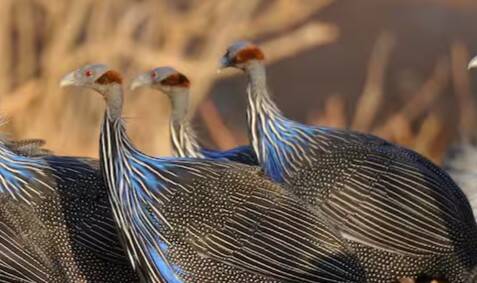
The natural world is full of fascinating phenomena, and one of the most striking examples is the vulturine guinea fowl’s electric blue feathers. These birds, found in the open savannas of Africa, have a remarkable appearance that has long been a subject of interest for scientists and bird enthusiasts alike. Recent research has revealed that the vulturine guinea fowl’s blue feathers contain no pigment, and instead, the color is created by microscopic feather structures that scatter light, reflecting only blue wavelengths.
This unique phenomenon is known as structural coloration, where the physical structure of the feathers interacts with light to produce the desired color. In the case of the vulturine guinea fowl, the microscopic structure of the feathers is made up of tiny, flat platelets called melanosomes. These platelets are arranged in a specific pattern, which allows them to scatter light in a way that favors the reflection of blue wavelengths, giving the feathers their characteristic electric blue color.
The use of structural coloration by the vulturine guinea fowl is not only aesthetically pleasing but also serves an important purpose in the bird’s survival and communication. The bright blue feathers help the birds to stand out in the open savannas, where they can be easily seen by other members of their flock. This is particularly important for communication and mating, as the birds use their bright plumage to signal their presence and attract potential mates.
In addition to its role in communication, the vulturine guinea fowl’s structural coloration also plays a crucial role in its survival. The bird’s blue feathers help to confuse predators, making it more difficult for them to single out individual birds in a flock. This is especially important in the open savannas, where predators such as lions, leopards, and eagles are common.
The discovery of the vulturine guinea fowl’s structural coloration has also inspired research in optics and materials science. Scientists are interested in understanding the precise mechanisms by which the bird’s feathers interact with light to produce the desired color, and how this can be replicated in artificial materials. This research has the potential to lead to the development of new materials and technologies, such as more efficient solar cells and more effective camouflage systems.
One of the most promising areas of research inspired by the vulturine guinea fowl’s structural coloration is in the field of biomimicry. Biomimicry is the practice of using nature as a source of inspiration for the design of new materials and technologies. By studying the microscopic structure of the vulturine guinea fowl’s feathers, scientists can gain insights into the design of new materials that can mimic the bird’s remarkable color-producing abilities.
For example, researchers have been working on the development of new materials that can produce structural coloration similar to that of the vulturine guinea fowl. These materials have the potential to be used in a wide range of applications, from cosmetics and textiles to biomedical devices and aerospace engineering.
In conclusion, the vulturine guinea fowl’s use of light to produce its electric blue feathers is a remarkable example of the natural world’s ability to inspire and fascinate us. The bird’s structural coloration is not only a beautiful phenomenon but also serves an important purpose in its survival and communication. As scientists continue to study the vulturine guinea fowl’s remarkable feathers, we can expect to see new breakthroughs in our understanding of optics and materials science, and the development of new technologies inspired by nature.
About the Author