Vulturine Guinea Fowl Uses Light to Look Blue Instead of Pigment
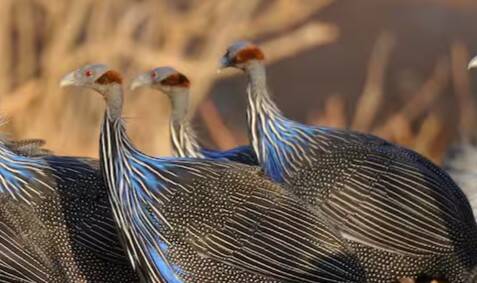
The natural world is full of fascinating examples of how living organisms have evolved to adapt to their environments. One such example is the vulturine guinea fowl, a bird species found in the savannas of East Africa. What makes this bird particularly interesting is its striking electric blue feathers, which are not actually blue due to the presence of pigment. Instead, scientists have discovered that the colour comes from microscopic feather structures that scatter light, reflecting only blue wavelengths.
This phenomenon is known as structural colour, where the physical structure of the material, in this case, the feathers, determines the colour we see. The vulturine guinea fowl’s feathers contain tiny, crystalline structures that refract and reflect light, giving the appearance of a vibrant blue colour. This is in contrast to most other birds, whose feathers contain pigments such as melanin or carotenoids that absorb certain wavelengths of light and reflect others, resulting in the colours we see.
The vulturine guinea fowl’s unique feather structure is not just a matter of aesthetics; it plays a crucial role in the bird’s communication and survival. In the open savannas where the bird lives, visibility is key, and the bright blue colouration helps the birds to stand out and signal to each other. The colour may also serve as a warning to potential predators, indicating that the bird is toxic or distasteful.
But how exactly do the microscopic feather structures produce this blue colour? Research has shown that the feathers contain tiny, plate-like structures called melanosomes, which are made up of the protein melanin. However, unlike in other birds, the melanosomes in the vulturine guinea fowl’s feathers are not packed tightly together, but are instead arranged in a specific pattern that allows them to scatter light.
When light hits the feathers, it encounters the melanosomes and is scattered in all directions. However, the specific shape and arrangement of the melanosomes mean that only blue wavelengths of light are reflected back to our eyes, giving the appearance of a bright blue colour. This is known as Rayleigh scattering, the same phenomenon that causes the sky to appear blue.
The discovery of the vulturine guinea fowl’s structural colour has significant implications for our understanding of optics and materials science. By studying the microscopic structures that produce this colour, scientists can gain insights into the properties of light and how it interacts with matter. This knowledge can be used to develop new materials and technologies, such as more efficient solar cells or advanced optical devices.
In addition, the study of structural colour in birds and other animals can inspire new approaches to colour production and manipulation. For example, researchers are exploring the use of nanostructures to create new types of pigments and dyes that can produce a range of colours without the need for traditional pigments.
The vulturine guinea fowl’s remarkable feathers are also a reminder of the incredible diversity and complexity of the natural world. The evolution of structural colour in this bird is a testament to the incredible adaptability and creativity of living organisms, and highlights the importance of continued research and exploration of the natural world.
In conclusion, the vulturine guinea fowl’s use of light to produce its striking blue colour is a fascinating example of the complex and often surprising ways in which living organisms interact with their environments. By studying this phenomenon, scientists can gain a deeper understanding of the natural world and develop new technologies and materials that can benefit society as a whole.
About the Author