Vulturine Guinea Fowl Uses Light to Look Blue Instead of Pigment
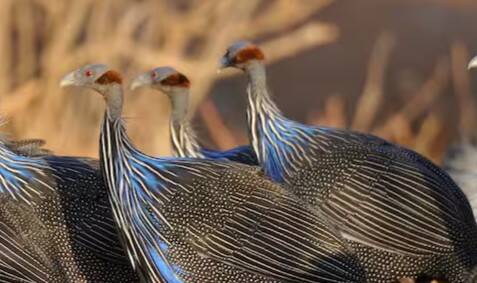
The natural world is full of fascinating phenomena, and one of the most striking examples is the vibrant plumage of birds. Among the many species of birds, the vulturine guinea fowl stands out for its stunning electric blue feathers. What’s remarkable about these feathers is that they don’t contain any pigment, despite their intense blue color. So, how do these birds manage to achieve such a striking appearance? The answer lies in the microscopic structure of their feathers, which scatter light in a way that reflects only blue wavelengths.
To understand this phenomenon, let’s delve into the world of structural coloration. Unlike pigment-based colors, which absorb certain wavelengths of light and reflect others, structural colors are created by the way light interacts with microscopic structures. In the case of the vulturine guinea fowl, the feathers contain tiny, plate-like structures called melanosomes. These melanosomes are made up of the protein melanin, which is also responsible for skin and hair color in humans. However, in the vulturine guinea fowl, the melanosomes are arranged in a specific way that creates a diffraction grating effect.
When light hits the feathers, it encounters the melanosomes and is scattered in all directions. However, the specific arrangement of the melanosomes means that only blue wavelengths are reflected back to our eyes, giving the appearance of a vibrant blue color. This effect is similar to the way a prism works, where white light is split into its individual colors. In the case of the vulturine guinea fowl, the microscopic structure of the feathers acts as a biological prism, creating the illusion of a blue pigment.
But why is this blue color so important for the vulturine guinea fowl? The answer lies in the bird’s social behavior and habitat. These birds live in open savannas, where communication and visibility are crucial for survival. The bright blue coloration of the vulturine guinea fowl serves as a visual signal, helping individuals to recognize one another and maintain social bonds within the flock. The color may also play a role in mate attraction and territorial displays, where the intensity and vibrancy of the blue feathers can be an indicator of an individual’s health and fitness.
The study of the vulturine guinea fowl’s structural coloration has also inspired research in optics and materials science. By understanding how the microscopic structure of the feathers creates the blue color, scientists can develop new materials and technologies that mimic this effect. For example, researchers are working on creating synthetic materials that can replicate the diffraction grating effect, potentially leading to new applications in fields such as optics, photonics, and biomedicine.
One potential application of this research is in the development of more efficient solar cells. By creating materials that can scatter light in a specific way, scientists may be able to increase the amount of energy that is absorbed by solar cells, leading to more efficient energy harvesting. Another potential application is in the field of biomedical imaging, where materials that can scatter light in specific ways could be used to create more detailed and accurate images of the body.
In addition to its potential applications, the study of the vulturine guinea fowl’s structural coloration has also shed light on the evolution of this phenomenon. Scientists believe that the blue coloration of the vulturine guinea fowl evolved as a result of the bird’s environment and social behavior. The open savannas where the birds live are characterized by intense sunlight and limited vegetation, making visibility and communication crucial for survival. The evolution of the blue coloration may have been driven by the need for a visual signal that could be seen from a distance, allowing individuals to recognize one another and maintain social bonds.
In conclusion, the vulturine guinea fowl’s electric blue feathers are a remarkable example of structural coloration in nature. The microscopic structure of the feathers, which scatters light in a specific way, creates the illusion of a blue pigment. This phenomenon has important implications for the bird’s social behavior and survival, and has also inspired research in optics and materials science. As scientists continue to study the vulturine guinea fowl and its remarkable feathers, we may uncover even more secrets about the natural world and develop new technologies that mimic its effects.
About the Author