Vulturine Guinea Fowl Uses Light to Look Blue Instead of Pigment
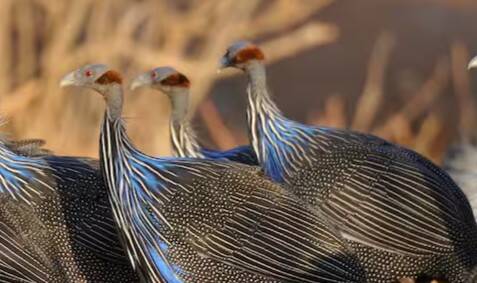
The natural world is full of fascinating examples of how living organisms have evolved to adapt to their environments. One such example is the vulturine guinea fowl, a bird species found in the savannas of East Africa. What makes this bird particularly interesting is its striking electric blue feathers, which are not actually blue due to the presence of any pigment. Instead, scientists have discovered that the colour of the vulturine guinea fowl’s feathers comes from microscopic structures within the feathers that scatter light, reflecting only blue wavelengths.
This phenomenon is known as structural colour, where the physical structure of an object determines its colour, rather than the presence of any pigment. In the case of the vulturine guinea fowl, the microscopic structures within its feathers are made up of tiny, plate-like melanin crystals that reflect light. When light hits these crystals, it is scattered in all directions, but the blue wavelengths are reflected back to our eyes, giving the appearance of electric blue feathers.
The use of structural colour by the vulturine guinea fowl is not just a matter of aesthetics; it also plays a crucial role in the bird’s communication and survival. In the open savannas where the vulturine guinea fowl lives, the striking blue colour of its feathers helps to identify individual birds and convey information about their status, health, and intentions. This is particularly important in a species that lives in large flocks, where effective communication is essential for cooperation and survival.
The vulturine guinea fowl’s use of structural colour is also an important adaptation for its environment. In the bright, sunny conditions of the savannas, the blue colour of the bird’s feathers helps to reduce glare and improve visibility. This is because the blue colour is more visible against the yellow-brown background of the savannas, making it easier for the birds to see each other and communicate.
The discovery of the vulturine guinea fowl’s structural colour has also inspired research in optics and materials science. Scientists are interested in understanding how the microscopic structures within the bird’s feathers produce the blue colour, and how this can be replicated in synthetic materials. This could have a range of applications, from the development of new types of displays and lighting, to the creation of more efficient solar cells and other optical devices.
One of the key challenges in replicating the vulturine guinea fowl’s structural colour is understanding the precise arrangement of the melanin crystals within its feathers. This requires the use of advanced imaging techniques, such as electron microscopy, to visualize the microscopic structures and determine how they interact with light. Scientists are also using computer simulations to model the behaviour of light as it interacts with the melanin crystals, and to predict how different arrangements of the crystals might produce different colours.
The study of the vulturine guinea fowl’s structural colour is also an example of how scientists can learn from nature to develop new technologies. This approach, known as biomimicry, involves studying the adaptations and solutions that have evolved in living organisms, and using these as inspiration for the development of new materials and technologies. By understanding how the vulturine guinea fowl’s feathers produce their striking blue colour, scientists may be able to develop new materials that have similar properties, such as high reflectivity and visibility.
In conclusion, the vulturine guinea fowl’s use of structural colour to produce its striking electric blue feathers is a fascinating example of how living organisms have evolved to adapt to their environments. The use of microscopic feather structures to scatter light and reflect only blue wavelengths is a remarkable phenomenon that has inspired research in optics and materials science. As scientists continue to study the vulturine guinea fowl and its remarkable feathers, they may uncover new insights into the natural world, and develop new technologies that are inspired by the adaptations of living organisms.
About the Author