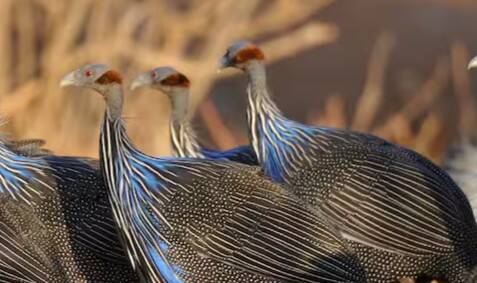
Vulturine Guinea Fowl Uses Light to Look Blue Instead of Pigment
The natural world is full of fascinating phenomena, and one of the most intriguing is the way that some animals use light to create color. The vulturine guinea fowl, a bird found in the savannas of East Africa, is a striking example of this. Its electric blue feathers are a sight to behold, but what’s even more remarkable is that they contain no pigment. So, how does the bird achieve this vibrant color? The answer lies in the microscopic structure of its feathers, which scatter light in such a way that only blue wavelengths are reflected.
This phenomenon is known as structural color, and it’s a key component of the vulturine guinea fowl’s remarkable appearance. The bird’s feathers are made up of tiny, branching melanin filaments that refract light and create the illusion of blue color. This is in contrast to pigment-based color, which is created by the absorption and reflection of light by molecules of pigment. In the case of the vulturine guinea fowl, the blue color is not due to the presence of any blue pigment, but rather the way that the microscopic structure of its feathers interacts with light.
But why is this important? The vulturine guinea fowl’s use of structural color is not just a curious phenomenon – it also plays a crucial role in the bird’s communication and survival. In the open savannas where the bird lives, its bright blue feathers serve as a signal to other members of its flock, helping to establish social bonds and warning off potential predators. The color is also an important factor in the bird’s mating and courtship rituals, with males using their vibrant plumage to attract females and establish dominance.
The study of the vulturine guinea fowl’s structural color is also inspiring research in optics and materials science. Scientists are fascinated by the way that the bird’s feathers are able to scatter light and create color, and are working to develop new materials and technologies that can replicate this effect. This could have a wide range of applications, from the development of more efficient solar cells to the creation of new types of display screens.
One of the key challenges in studying the vulturine guinea fowl’s structural color is understanding the precise mechanism by which its feathers scatter light. This requires a detailed analysis of the microscopic structure of the feathers, as well as the way that they interact with different wavelengths of light. Researchers are using a range of techniques, including electron microscopy and spectroscopy, to study the feathers and gain a deeper understanding of how they create color.
As our understanding of the vulturine guinea fowl’s structural color grows, so too do the potential applications of this technology. For example, researchers are exploring the possibility of using similar structures to create more efficient solar cells, which could help to harness the power of the sun and reduce our reliance on fossil fuels. The development of new display screens that use structural color could also have a major impact on the tech industry, enabling the creation of more vivid and realistic images.
In addition to its potential applications in technology, the study of the vulturine guinea fowl’s structural color is also providing new insights into the natural world. By understanding how the bird’s feathers create color, scientists are gaining a deeper appreciation for the complex and often surprising ways that animals interact with their environment. This is also highlighting the importance of conservation efforts, as the loss of species like the vulturine guinea fowl could have a major impact on the health of ecosystems around the world.
In conclusion, the vulturine guinea fowl’s use of light to create color is a remarkable phenomenon that is inspiring research in a range of fields. From the study of structural color to the development of new materials and technologies, this bird’s unique appearance is having a major impact on our understanding of the natural world. As we continue to learn more about the vulturine guinea fowl and its fascinating feathers, we are also reminded of the importance of conservation and the need to protect these incredible creatures and the ecosystems they inhabit.
About the Author