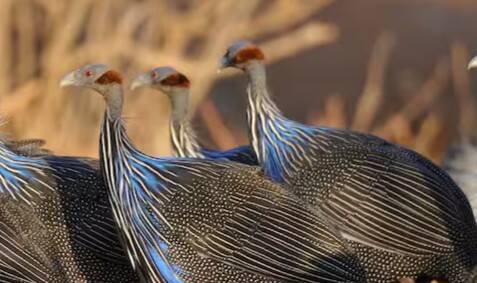
Vulturine Guinea Fowl Uses Light to Look Blue Instead of Pigment
The natural world is full of fascinating examples of how living organisms have evolved to adapt to their environments. One such example is the vulturine guinea fowl, a bird species found in the savannas of East Africa. What makes this bird unique is its striking electric blue feathers, which are not actually blue due to the presence of pigment, but rather due to a clever trick of light manipulation. In this blog post, we will delve into the science behind the vulturine guinea fowl’s remarkable plumage and explore the significance of this phenomenon in the fields of optics and materials science.
The Science of Structural Color
The vulturine guinea fowl’s blue feathers are a result of a phenomenon known as structural color. This occurs when the microscopic structure of a material scatters light in such a way that it reflects only specific wavelengths, creating the appearance of color. In the case of the vulturine guinea fowl, the feathers contain tiny, crystal-like structures that scatter light and reflect only blue wavelengths. This is in contrast to pigment-based colors, which absorb certain wavelengths of light and reflect others, resulting in the appearance of color.
The structural color of the vulturine guinea fowl’s feathers is not just a simple matter of reflecting blue light. The microscopic structures within the feathers are arranged in a specific way to create a diffraction grating, which is a pattern of tiny, evenly spaced lines or dots that bend light around them. This diffraction grating is responsible for scattering the light and reflecting only the blue wavelengths, giving the feathers their characteristic color.
Flock Communication and Survival
The vulturine guinea fowl’s striking blue feathers are not just for show; they also play a crucial role in the bird’s communication and survival. In the open savannas where the vulturine guinea fowl lives, it is essential to be able to communicate with other members of the flock quickly and effectively. The bright blue feathers serve as a visual signal, allowing the birds to recognize one another and coordinate their behavior.
For example, when a vulturine guinea fowl senses danger, it will often raise its blue feathers as a warning signal to other members of the flock. This allows the birds to respond quickly and take evasive action, increasing their chances of survival. The blue feathers also play a role in mating and courtship, with males using their bright plumage to attract females and establish dominance within the flock.
Inspiring Research in Optics and Materials Science
The vulturine guinea fowl’s remarkable structural color has not gone unnoticed by scientists. Researchers in the fields of optics and materials science are studying the microscopic structures within the bird’s feathers to gain a better understanding of how they scatter light and create the appearance of color. This knowledge has the potential to inspire new technologies and materials, such as more efficient solar cells, brighter displays, and even new types of camouflage.
For example, scientists are working on developing new materials that mimic the microscopic structure of the vulturine guinea fowl’s feathers. These materials could be used to create more efficient solar cells, which would be able to harness a wider range of wavelengths and convert them into energy. Similarly, researchers are exploring the use of structural color in displays, such as TV screens and mobile devices, to create brighter and more vivid images.
Conclusion
The vulturine guinea fowl’s use of light to create the appearance of blue feathers is a remarkable example of evolutionary adaptation. The bird’s structural color, which is created by the microscopic structure of its feathers, plays a crucial role in its communication and survival. As scientists continue to study the vulturine guinea fowl’s remarkable plumage, they are gaining a deeper understanding of the science behind structural color and its potential applications in optics and materials science.
The vulturine guinea fowl’s story is a testament to the incredible diversity and complexity of the natural world. By studying the unique characteristics of this and other species, we can gain a deeper appreciation for the intricate web of life on Earth and the many ways in which living organisms have evolved to thrive in their environments.
About the Author