Skull reveals some ancient humans had more ‘primitive’ faces
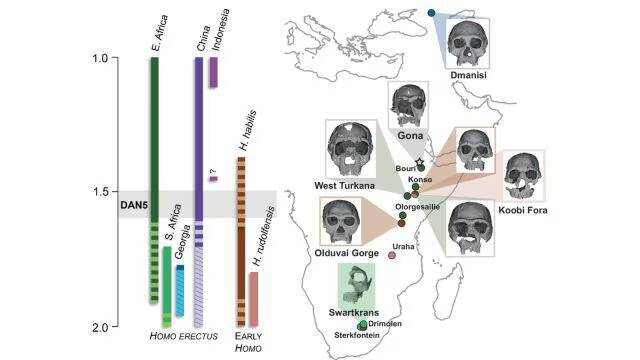
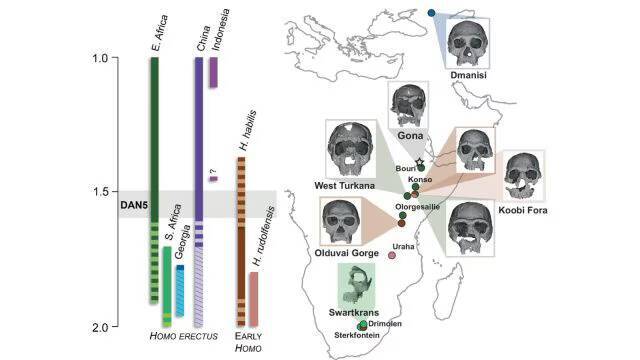
The study of human evolution has always been a fascinating topic, with new discoveries constantly reshaping our understanding of the history of our species. A recent finding has shed new light on the evolution of early Homo erectus, one of the earliest human ancestors. A reconstruction of a 1.5-1.6-million-year-old Homo erectus skull, known as DAN5, has revealed primitive facial traits that were not expected in a fossil of this age.
The DAN5 skull was discovered in Ethiopia and has been the subject of a recent study that used micro-CT modeling to analyze its structure. The results of the study have been surprising, with the skull showing a mix of modern and archaic features. According to Dr. Baab, one of the researchers involved in the study, “The face is more archaic than we anticipated.” The skull has a small braincase, which is paired with ancestral features such as a flat nasal bridge and large molars.
The discovery of the DAN5 skull has significant implications for our understanding of human evolution. The fact that the skull shows such primitive facial traits is surprising, given its relatively young age. As Yousuke Kaifu, another researcher involved in the study, noted, “Seeing such a primitive face on a fossil this young was surprising.” This finding suggests that human evolution was more complex and nuanced than previously thought, with different populations developing at different rates.
The study of the DAN5 skull has also highlighted the importance of micro-CT modeling in the field of paleoanthropology. This technique allows researchers to analyze the internal structure of fossils in detail, providing valuable insights into the evolution of human anatomy. By using micro-CT modeling to study the DAN5 skull, researchers were able to gain a more complete understanding of its structure and how it relates to other fossils from the same period.
The discovery of the DAN5 skull is also significant because it provides new evidence of the diversity of human evolution. The fact that this skull shows a mix of modern and archaic features suggests that human evolution was not a linear process, but rather a complex and branching one. This means that different populations of early humans may have developed at different rates, with some retaining more primitive traits than others.
The study of human evolution is an ongoing field of research, with new discoveries constantly shedding new light on our understanding of the history of our species. The discovery of the DAN5 skull is an important contribution to this field, providing new insights into the evolution of early Homo erectus. As researchers continue to study this fossil and others like it, we can expect to learn more about the complex and fascinating history of human evolution.
In conclusion, the discovery of the DAN5 skull has provided significant new insights into the evolution of early Homo erectus. The fact that this skull shows a mix of modern and archaic features, including a small braincase and primitive facial traits, is surprising and highlights the complexity of human evolution. As researchers continue to study this fossil and others like it, we can expect to learn more about the history of our species and the processes that have shaped us into what we are today.
The study of human evolution is a fascinating and complex field, with many different factors influencing the development of our species. The discovery of the DAN5 skull is an important reminder of the importance of continued research and study in this field, as we seek to understand the history of our species and the processes that have shaped us into what we are today.
As we continue to learn more about human evolution, we are reminded of the importance of preserving and protecting our cultural and scientific heritage. The discovery of fossils like the DAN5 skull is a significant contribution to our understanding of human evolution, and it is essential that we continue to support and fund research in this field.
In the end, the study of human evolution is a complex and ongoing field of research, with many different factors influencing the development of our species. The discovery of the DAN5 skull is an important contribution to this field, providing new insights into the evolution of early Homo erectus. As we continue to learn more about human evolution, we are reminded of the importance of continued research and study in this field, as we seek to understand the history of our species and the processes that have shaped us into what we are today.
About the Author