Skull reveals some ancient humans had more ‘primitive’ faces
The discovery of a 1.5-1.6-million-year-old Homo erectus skull in Ethiopia has shed new light on the evolution of early humans. A recent study has revealed that this ancient skull, known as DAN5, exhibits more primitive facial traits than previously thought. The findings have sparked surprise among scientists, who had anticipated a more modern face for a fossil of this age.
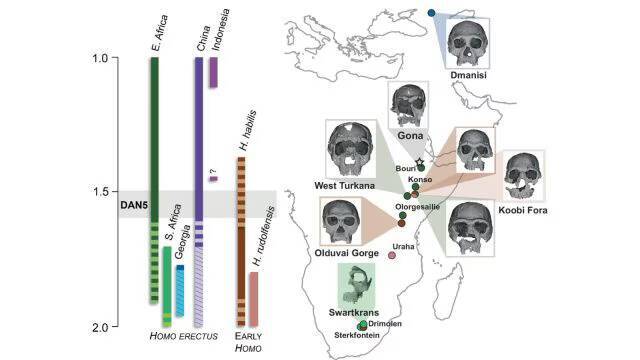
The research team, led by Dr. Baab, used advanced micro-CT modelling techniques to reconstruct the DAN5 skull. The results showed a small braincase paired with ancestral features, including a flat nasal bridge and large molars. According to Dr. Baab, “The face is more archaic than we anticipated.” This primitive facial structure is reminiscent of earlier human ancestors, such as Homo habilis, which lived around 2.8-1.4 million years ago.
The discovery of the DAN5 skull has significant implications for our understanding of human evolution. The Homo erectus species is thought to have played a crucial role in the migration of early humans out of Africa, and their fossils have been found in various parts of the world, including Asia and Europe. However, the DAN5 skull suggests that the evolution of Homo erectus was more complex and nuanced than previously thought.
Yousuke Kaifu, a researcher involved in the study, expressed surprise at the primitive features of the DAN5 skull. “Seeing such a primitive face on a fossil this young was surprising,” he said. The age of the skull, which is estimated to be around 1.5-1.6 million years old, is relatively young compared to other Homo erectus fossils. This has led scientists to re-evaluate their assumptions about the evolution of the species.
The study’s findings have also raised questions about the pace of human evolution. The presence of primitive facial traits in a relatively young fossil suggests that the evolution of modern human features may have been a more gradual process than previously thought. This challenges the traditional view of human evolution, which assumes a more linear and progressive development of modern traits.
The discovery of the DAN5 skull is also significant because it highlights the importance of continued exploration and research into human evolution. The fossil record is incomplete, and new discoveries can significantly impact our understanding of human history. The study of ancient human fossils like DAN5 can provide valuable insights into the lives and environments of our ancestors, and can help us better understand the complex and often surprising history of human evolution.
In conclusion, the reconstruction of the DAN5 skull has revealed a more primitive face than anticipated, with ancestral features such as a flat nasal bridge and large molars. The study’s findings have significant implications for our understanding of human evolution, and highlight the importance of continued research and exploration into the history of our species. As scientists continue to study and learn from fossils like DAN5, we can expect to gain a deeper understanding of the complex and fascinating story of human evolution.
The study of human evolution is an ongoing and dynamic field, with new discoveries and advancements in technology continually shedding new light on our understanding of the past. As we continue to explore and learn from the fossil record, we can expect to uncover more surprises and challenges to our current understanding of human evolution. The discovery of the DAN5 skull is a significant contribution to this field, and will undoubtedly play a important role in shaping our understanding of the history of our species.
The importance of this discovery cannot be overstated, as it has the potential to reshape our understanding of early Homo erectus evolution. The fact that the DAN5 skull exhibits more primitive facial traits than anticipated suggests that the evolution of Homo erectus was more complex and nuanced than previously thought. This has significant implications for our understanding of human evolution, and highlights the need for continued research and exploration into the history of our species.
As we move forward in our understanding of human evolution, it is essential that we continue to explore and learn from the fossil record. The study of ancient human fossils like DAN5 can provide valuable insights into the lives and environments of our ancestors, and can help us better understand the complex and often surprising history of human evolution. By continuing to study and learn from these fossils, we can gain a deeper understanding of the history of our species, and can shed new light on the complex and fascinating story of human evolution.
About the Author