Skull reveals some ancient humans had more ‘primitive’ faces
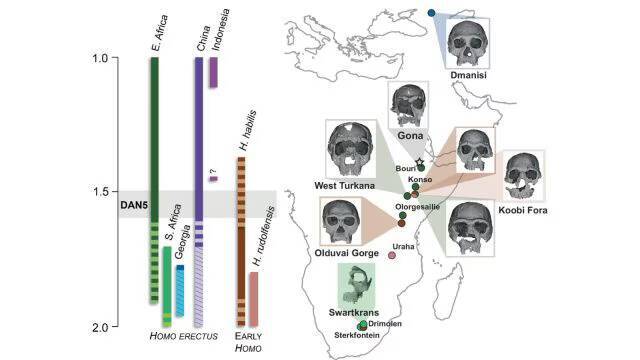
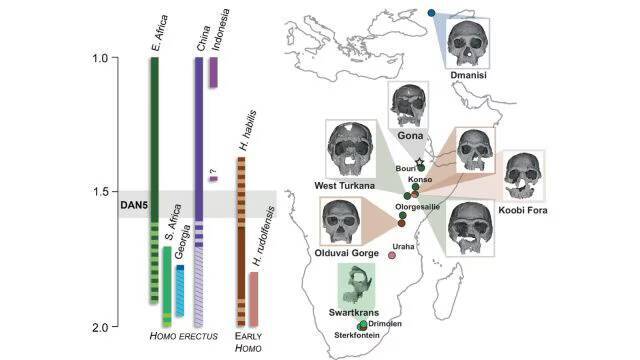
The discovery of a 1.5-1.6-million-year-old Homo erectus skull in Ethiopia has shed new light on the evolution of early humans. A recent study has revealed that this ancient skull, known as DAN5, exhibits more primitive facial traits than previously thought. The findings have left scientists surprised and have reshaped our understanding of the early Homo erectus evolution.
The DAN5 skull was discovered in the Gona Paleoanthropological Research Project area in Ethiopia, a region known for its rich fossil deposits. The skull was found to be remarkably well-preserved, with many of its original features still intact. To gain a deeper understanding of the skull’s structure, researchers used micro-CT modeling, a technique that allows for the creation of detailed 3D models of the fossil.
The results of the micro-CT modeling revealed a small braincase paired with ancestral features, including a flat nasal bridge and large molars. These characteristics are more commonly associated with earlier human ancestors, such as Homo habilis, rather than the more advanced Homo erectus. “The face is more archaic than we anticipated,” said Dr. Baab, one of the lead researchers on the study. “Seeing such a primitive face on a fossil this young was surprising,” added Yousuke Kaifu, another researcher involved in the study.
The discovery of the DAN5 skull has significant implications for our understanding of human evolution. It suggests that the evolution of Homo erectus was more complex and nuanced than previously thought. The presence of primitive facial traits on a fossil from this time period challenges the traditional view of human evolution, which held that Homo erectus was a more advanced and modern species.
The study’s findings also highlight the importance of continued exploration and research into the fossil record. The discovery of the DAN5 skull is a testament to the fact that there is still much to be learned about human evolution, and that new discoveries can significantly impact our understanding of the past.
One of the most significant aspects of the DAN5 skull is its age. At 1.5-1.6 million years old, it is one of the youngest fossils to exhibit such primitive facial traits. This has led researchers to question the traditional view of human evolution, which held that Homo erectus was a more advanced species that had already developed many of the characteristics we associate with modern humans.
The discovery of the DAN5 skull also underscores the importance of considering the diversity of human evolution. The presence of primitive facial traits on a fossil from this time period suggests that there may have been multiple evolutionary pathways, and that the evolution of Homo erectus was not a linear process.
The study’s findings have also sparked debate among researchers about the classification of the DAN5 skull. Some have argued that the skull’s primitive facial traits suggest that it may be a member of a previously unknown species, while others believe that it is simply a variant of Homo erectus.
Regardless of its classification, the DAN5 skull is an important discovery that has shed new light on the evolution of early humans. Its primitive facial traits and small braincase have challenged our traditional views of human evolution, and have highlighted the complexity and nuance of the fossil record.
In conclusion, the discovery of the 1.5-1.6-million-year-old Homo erectus skull DAN5 has significant implications for our understanding of human evolution. The skull’s primitive facial traits and small braincase have challenged our traditional views of human evolution, and have highlighted the importance of continued research and exploration into the fossil record. As we continue to learn more about the DAN5 skull and its place in the fossil record, we may uncover even more surprises that will reshape our understanding of the evolution of our species.
About the Author