Skull reveals some ancient humans had more ‘primitive’ faces
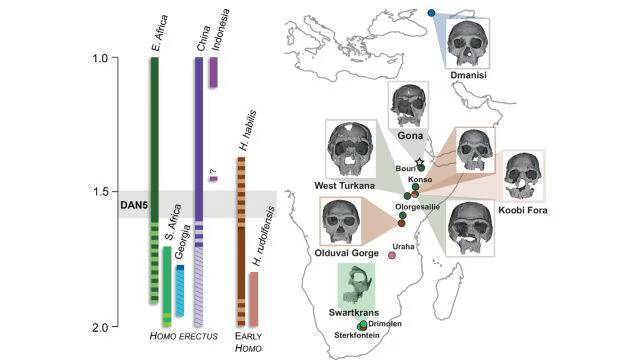
The field of paleoanthropology has long been fascinated by the evolution of the human face. For decades, scientists have been studying the fossil records of ancient humans, trying to understand how our facial features have changed over time. A recent study has shed new light on this topic, revealing that some ancient humans had more “primitive” faces than previously thought. The discovery was made possible by the analysis of a 1.5-1.6-million-year-old Homo erectus skull, known as DAN5, which was found in Ethiopia.
The DAN5 skull was reconstructed using advanced micro-CT modeling techniques, which allowed researchers to create a detailed 3D image of the fossil. The results were surprising, to say the least. According to Dr. Baab, one of the lead researchers on the project, “The face is more archaic than we anticipated.” The skull showed a small braincase paired with ancestral features, including a flat nasal bridge and large molars. These characteristics are typically associated with more primitive human ancestors, such as Homo habilis.
The discovery of the DAN5 skull has significant implications for our understanding of human evolution. As Yousuke Kaifu, another researcher on the project, noted, “Seeing such a primitive face on a fossil this young was surprising.” The fact that the skull is relatively young, in geological terms, suggests that some ancient humans retained more primitive facial features for longer than previously thought. This challenges the traditional view of human evolution, which assumes a more linear progression from primitive to modern features.
The study of the DAN5 skull also highlights the importance of micro-CT modeling in paleoanthropology. This technique allows researchers to non-invasively examine the internal structure of fossils, revealing details that would be impossible to see with the naked eye. In the case of the DAN5 skull, micro-CT modeling revealed a number of interesting features, including the presence of a small braincase and a primitive dental structure.
The discovery of the DAN5 skull also raises questions about the evolution of the human face. Why did some ancient humans retain more primitive facial features, while others developed more modern characteristics? What factors drove the evolution of the human face, and how did these factors vary across different populations? These are questions that will likely be the subject of ongoing research and debate in the field of paleoanthropology.
One possible explanation for the retention of primitive facial features in some ancient humans is the concept of “evolutionary stasis.” This refers to the idea that some populations may remain relatively unchanged over long periods of time, due to a lack of selective pressure or other factors. In the case of the DAN5 skull, it is possible that the population to which it belonged was subject to relatively little selective pressure, allowing them to retain more primitive facial features.
Another possible explanation is the concept of “mosaic evolution.” This refers to the idea that different parts of the body may evolve at different rates, resulting in a “mosaic” of primitive and modern characteristics. In the case of the DAN5 skull, the combination of a small braincase and primitive facial features may be an example of mosaic evolution, where different parts of the body have evolved at different rates.
In conclusion, the discovery of the DAN5 skull is a significant find that sheds new light on the evolution of the human face. The fact that some ancient humans retained more primitive facial features for longer than previously thought challenges our traditional view of human evolution and highlights the importance of ongoing research in the field of paleoanthropology. As scientists continue to study the fossil record and develop new techniques for analyzing ancient remains, we can expect to learn even more about the complex and fascinating history of the human face.
About the Author