Skull reveals some ancient humans had more ‘primitive’ faces
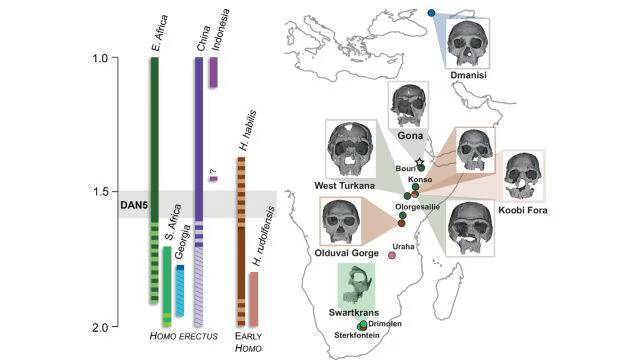
The study of human evolution has always been a fascinating field, with new discoveries constantly reshaping our understanding of the history of our species. Recently, a team of researchers made a groundbreaking discovery in the form of a 1.5-1.6-million-year-old Homo erectus skull, known as DAN5, which has provided significant insights into the evolution of early humans. The reconstruction of this ancient skull has revealed some surprising features, including a more primitive face than previously anticipated.
According to Dr. Baab, one of the researchers involved in the study, “The face is more archaic than we anticipated.” This is a significant finding, as it challenges our previous understanding of the evolution of Homo erectus, a species that is thought to be a key transitional phase between earlier human ancestors and modern humans. The discovery of the DAN5 skull in Ethiopia has provided a unique opportunity for scientists to study the facial structure of early humans in greater detail.
Using micro-CT modelling, the researchers were able to create a detailed reconstruction of the DAN5 skull, which revealed a small braincase paired with ancestral features, including a flat nasal bridge and large molars. These characteristics are more commonly associated with earlier human ancestors, such as Homo habilis, rather than Homo erectus, which is thought to have had a more modern human-like face.
Yousuke Kaifu, another researcher involved in the study, expressed surprise at the primitive features of the DAN5 skull, saying, “Seeing such a primitive face on a fossil this young was surprising.” This sentiment is echoed by other experts in the field, who are eager to learn more about the implications of this discovery for our understanding of human evolution.
The discovery of the DAN5 skull has significant implications for our understanding of the evolution of Homo erectus. Previously, it was thought that this species had a more modern human-like face, with a larger braincase and more advanced facial features. However, the reconstruction of the DAN5 skull suggests that this may not have been the case, and that some early humans may have had more primitive faces than previously thought.
This finding also raises questions about the pace and pattern of human evolution. If some early humans had more primitive faces, does this mean that the evolution of modern human-like facial features was a more gradual process than previously thought? Or were there multiple lines of evolution, with some species developing more advanced features while others retained more primitive characteristics?
The study of the DAN5 skull also highlights the importance of continued exploration and discovery in the field of human evolution. The discovery of new fossils and the development of new technologies, such as micro-CT modelling, are allowing scientists to study the history of our species in greater detail than ever before.
As our understanding of human evolution continues to grow and evolve, it is likely that we will encounter more surprises and challenges to our current theories. However, it is through the discovery of new evidence and the application of new technologies that we will ultimately gain a more complete and accurate understanding of the history of our species.
In conclusion, the discovery of the 1.5-1.6-million-year-old Homo erectus skull DAN5 has provided significant insights into the evolution of early humans. The reconstruction of this ancient skull has revealed a more primitive face than previously anticipated, with ancestral features such as a flat nasal bridge and large molars. This finding has significant implications for our understanding of human evolution, and highlights the importance of continued exploration and discovery in this field.
As we continue to learn more about the history of our species, it is likely that we will encounter more surprises and challenges to our current theories. However, it is through the discovery of new evidence and the application of new technologies that we will ultimately gain a more complete and accurate understanding of the evolution of humanity.
About the Author