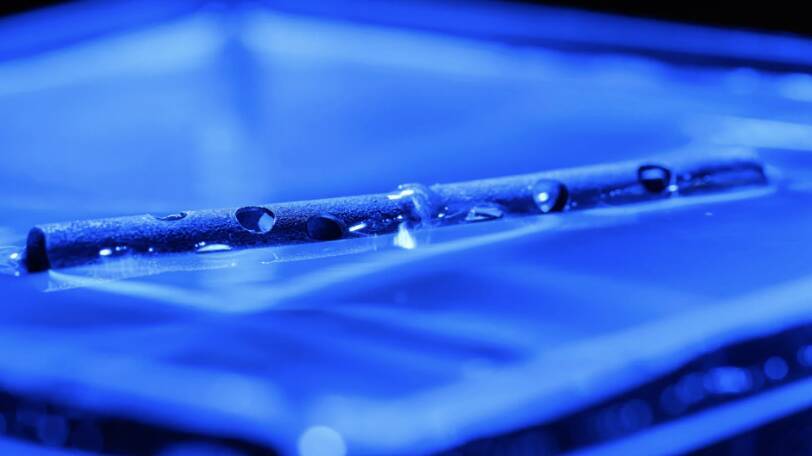
Scientists develop metal tubes that could enable unsinkable ships
The concept of an “unsinkable ship” has long been a topic of fascination and debate among naval architects, engineers, and scientists. While we have made significant advancements in shipbuilding and safety technologies, the risk of sinking remains a persistent concern, particularly in harsh marine environments. However, a recent breakthrough in materials science may revolutionize the way we design and build ships, potentially making them unsinkable. Scientists have developed a highly buoyant metal tube structure by processing aluminium that can float even when submerged for long periods or damaged with holes.
The innovative technology involves creating nanometer-scale grooves on the surface of aluminium tubes, making them superhydrophobic. This unique property allows the metal tubes to stably maintain air bubbles on their inner surface, even when submerged in water. The result is a lightweight, yet incredibly buoyant structure that can withstand significant damage without compromising its ability to stay afloat. This breakthrough has significant implications for the shipping industry, as it could enable the development of unsinkable ships that are better equipped to withstand the harsh conditions of the open sea.
The researchers behind this innovation achieved the superhydrophobic effect by adding microscopic grooves to the aluminium tubes. These grooves, measuring only a few nanometers in depth, create a unique surface topography that repels water and allows air bubbles to form and persist on the inner surface of the tubes. This phenomenon is known as the “lotus effect,” named after the self-cleaning properties of the lotus leaf, which has a similar surface structure. By mimicking this natural phenomenon, the scientists were able to create a metal surface that is not only water-repellent but also able to maintain a stable layer of air bubbles, even under significant pressure.
The potential applications of this technology are vast and varied. In the shipping industry, unsinkable ships could revolutionize the way we transport goods and people across the world’s oceans. No longer would ships be at risk of sinking due to damage or flooding, reducing the risk of loss of life and cargo. This could also lead to significant economic benefits, as shipping companies and insurers would no longer need to factor in the risk of sinking when calculating their costs and premiums.
Moreover, the development of unsinkable ships could also have a major impact on the environment. Oil spills and other marine pollution incidents often occur when ships sink or are damaged, releasing toxic substances into the ocean. By reducing the risk of sinking, we can also reduce the risk of environmental disasters, protecting marine ecosystems and preserving the health of our oceans.
The technology could also have applications beyond the shipping industry. For example, it could be used to develop more efficient and sustainable offshore platforms for oil and gas production, or to create innovative new structures for coastal protection and erosion prevention. The possibilities are endless, and it will be exciting to see how this technology is developed and applied in the years to come.
While the development of unsinkable ships is still in its infancy, the potential benefits are undeniable. As scientists and engineers continue to refine and improve this technology, we can expect to see significant advancements in the field of materials science and naval architecture. The future of shipping and marine transportation is looking brighter than ever, thanks to the innovative work of researchers and scientists around the world.
In conclusion, the development of metal tubes that can float even when submerged or damaged is a groundbreaking achievement that could enable the creation of unsinkable ships. By harnessing the power of superhydrophobic surfaces and nanotechnology, scientists have opened up new possibilities for the shipping industry and beyond. As we continue to explore and develop this technology, we can expect to see significant improvements in safety, efficiency, and sustainability. The era of unsinkable ships may soon be upon us, and it’s an exciting prospect that could revolutionize the way we travel and transport goods across the world’s oceans.
News source: https://www.sciencedaily.com/releases/2026/01/260130041105.htm
About the Author