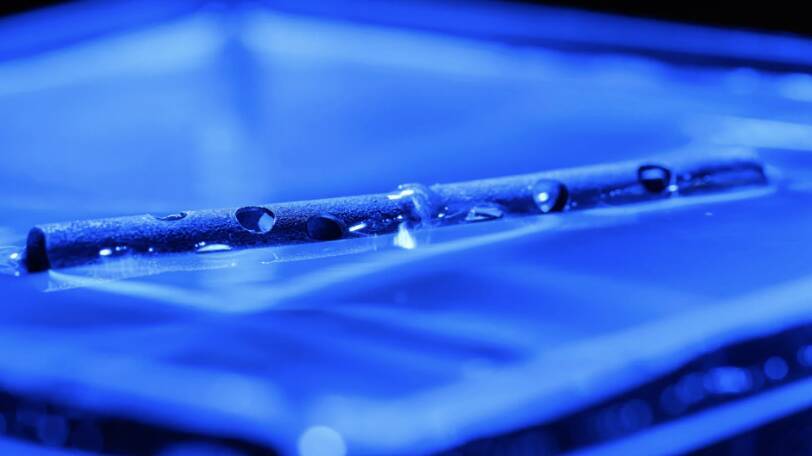
Scientists develop metal tubes that could enable unsinkable ships
For centuries, shipbuilders have been searching for ways to make vessels more buoyant and resilient in the face of harsh marine environments. While significant advances have been made in ship design and materials, the risk of sinking remains a persistent threat to maritime safety. However, a groundbreaking discovery by scientists may be about to change the game. By developing a highly buoyant metal tube structure, researchers have created a material that can float even when submerged for long periods or damaged with holes. This innovative technology has the potential to revolutionize the shipping industry and make “unsinkable ships” a reality.
The secret to this remarkable material lies in its unique surface properties. By adding nanometer-scale grooves to aluminium tubes, the scientists created a superhydrophobic surface that is able to stably maintain air bubbles on the inner surface. This property, known as the “lotus effect,” allows the metal tubes to repel water and retain air pockets, even when submerged in water. As a result, the tubes are able to stay afloat, even when damaged or punctured.
The development of this technology is a significant breakthrough in materials science. Traditional metals, such as aluminium, are denser than water and tend to sink when submerged. However, by manipulating the surface properties of the metal, the researchers were able to create a material that defies this fundamental principle. The implications of this discovery are far-reaching, with potential applications in a wide range of fields, from maritime engineering to aerospace.
One of the most exciting possibilities is the development of unsinkable ships. By incorporating the buoyant metal tubes into ship design, builders could create vessels that are virtually indestructible. Even if a ship were to suffer significant damage, the metal tubes would continue to provide buoyancy, keeping the vessel afloat. This technology could be particularly useful for ships that operate in hazardous environments, such as oil tankers or cargo vessels that travel through treacherous waters.
The potential benefits of this technology extend beyond the shipping industry. The development of superhydrophobic materials could also have significant implications for other fields, such as aerospace and biomedical engineering. For example, the ability to create materials that can repel water and maintain air pockets could be used to develop more efficient and durable aircraft, or to create implantable devices that can withstand the harsh conditions of the human body.
The researchers behind this discovery are eager to explore the full potential of their technology. By continuing to refine and develop their material, they hope to create a new generation of unsinkable ships that are safer, more efficient, and more environmentally friendly. As the world becomes increasingly dependent on maritime trade and transportation, the need for innovative solutions to improve ship safety and sustainability has never been more pressing.
The development of buoyant metal tubes is a significant step forward in this effort. By harnessing the power of nanotechnology and materials science, scientists have created a material that is capable of defying the fundamental principles of density and buoyancy. As this technology continues to evolve and improve, it is likely to have a profound impact on the shipping industry and beyond.
In conclusion, the discovery of buoyant metal tubes is a groundbreaking development that has the potential to revolutionize the shipping industry. By creating a material that can float even when submerged or damaged, scientists have opened up new possibilities for the design and construction of unsinkable ships. As this technology continues to advance, it is likely to have far-reaching implications for a wide range of fields, from maritime engineering to aerospace and biomedical engineering. With its potential to improve ship safety, efficiency, and sustainability, this innovation is an exciting step forward in the pursuit of a more secure and environmentally friendly maritime future.
News source: https://www.sciencedaily.com/releases/2026/01/260130041105.htm
About the Author