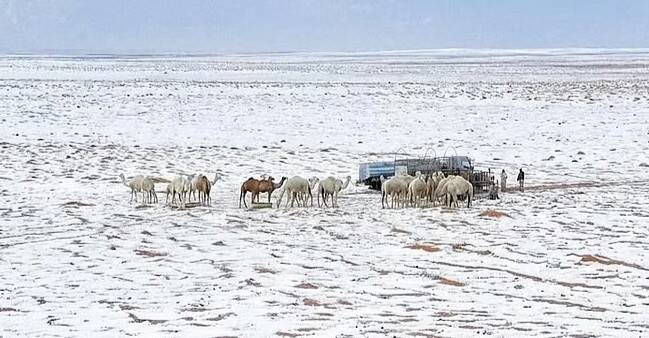
Saudi Deserts Once Had Rivers, Lakes, and Grasslands: Study
The deserts of Saudi Arabia are known for their harsh and arid conditions, with endless dunes of sand stretching as far as the eye can see. However, new studies have revealed that this was not always the case. In fact, Saudi Arabia’s deserts were once rich landscapes with rivers, lakes, and vast grasslands that supported a wide range of plants, animals, and early humans. The discovery has shed new light on the region’s history and has significant implications for our understanding of the Earth’s climate.
The study, which was conducted by a team of scientists, found that the Rub’ al-Khali, also known as the Empty Quarter, was once a huge lake. The Rub’ al-Khali is the largest sand desert in the world, covering an area of over 650,000 square kilometers. Today, it is an ocean of sand, with dunes reaching heights of over 250 meters. However, during wetter climatic phases, the area was home to a massive lake that supported a wide range of aquatic life, including hippos, crocodiles, and other water-dependent species.
The researchers used a combination of geological and archaeological evidence to reconstruct the region’s past. They analyzed sediment cores, fossil records, and other data to build a picture of what the area was like thousands of years ago. The results were surprising, with evidence of rivers, lakes, and grasslands stretching across the region.
One of the most significant findings was the discovery of fossilized remains of hippos and crocodiles in the Rub’ al-Khali. These animals are typically found in aquatic environments, and their presence in the desert suggests that the area was once much wetter than it is today. The researchers also found evidence of ancient rivers and lakes, including fossilized riverbeds and lake sediments.
The study suggests that the climate in the region was much more hospitable in the past, with more rainfall and a more stable water supply. This allowed for the growth of grasslands and other vegetation, which in turn supported a wide range of wildlife. The presence of early humans in the region is also well-documented, with archaeological evidence showing that people lived in the area thousands of years ago.
So, what happened to the rivers, lakes, and grasslands of Saudi Arabia? The answer lies in the Earth’s climate. Over the past few thousand years, the climate in the region has shifted, with less rainfall and a more unstable water supply. This has led to the drying up of rivers and lakes, and the expansion of the desert. The process has been gradual, with the desert slowly reclaiming the land over thousands of years.
The study has significant implications for our understanding of the Earth’s climate. It shows that even the driest and most inhospitable regions on Earth have a rich and varied history, with periods of significant climate change. The research also highlights the importance of preserving and protecting our natural environment, particularly in regions that are vulnerable to climate change.
In conclusion, the deserts of Saudi Arabia are not as barren and lifeless as they seem. In fact, they have a rich and varied history, with evidence of rivers, lakes, and grasslands stretching across the region. The study is a reminder that the Earth’s climate is constantly changing, and that even the most inhospitable regions on Earth have the potential to support life. As we look to the future, it is essential that we take steps to protect and preserve our natural environment, particularly in regions that are vulnerable to climate change.
The discovery of Saudi Arabia’s lush past is a fascinating one, and it highlights the importance of continued research and exploration into the Earth’s history. By studying the past, we can gain a better understanding of the present and make predictions about the future. The study is a significant contribution to our knowledge of the Earth’s climate and has the potential to inform policy and decision-making in the years to come.
In the end, the study of Saudi Arabia’s deserts is a reminder that even the most seemingly barren and lifeless regions on Earth have a rich and varied history. It is a testament to the power of science and research to reveal new and exciting information about our world, and it highlights the importance of continued exploration and discovery.
About the Author