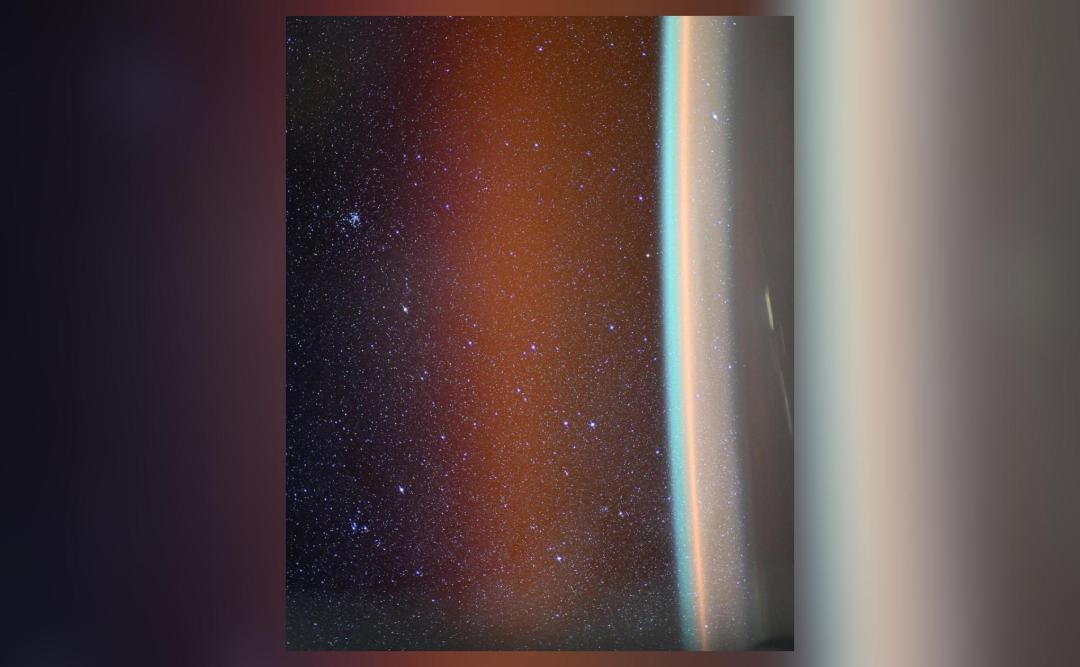
Pic shows colours of Earth’s atmosphere as seen from space
The Earth’s atmosphere is a complex and fascinating system that has captivated human imagination for centuries. From the deep blues and whites of the clouds to the vibrant hues of the aurora borealis, our atmosphere is a kaleidoscope of colors that are both beautiful and awe-inspiring. Recently, an image captured from the International Space Station (ISS) has given us a glimpse into the breathtaking colors of the Earth’s atmosphere as seen from space.
The image, which was shared by NASA astronaut Don Pettit, shows the bright colors of the Earth’s atmosphere in stunning detail. “Multiple vibrant layers of green atomic oxygen, orange hydroxyl radicals, and red airglow excited from solar activity,” Pettit wrote in the caption. The image is a testament to the incredible beauty of the Earth’s atmosphere and the complex processes that shape it.
One of the most striking features of the image is the presence of airglow, which is a phenomenon that occurs when atoms and molecules in the upper atmosphere are excited by sunlight and emit light in order to shed their excess energy. Airglow is a natural process that occurs in the Earth’s atmosphere, and it is responsible for the vibrant colors that we see in the image. The airglow is excited by solar activity, which means that it is influenced by the sun’s energy and can vary in intensity and color depending on the time of day and the level of solar activity.
The image also shows the different layers of the atmosphere, each with its own unique characteristics and colors. The green layer, which is composed of atomic oxygen, is a result of the excitation of oxygen atoms by solar radiation. The orange layer, which is composed of hydroxyl radicals, is a result of the reaction between oxygen and hydrogen atoms in the upper atmosphere. The red layer, which is composed of airglow excited by solar activity, is a result of the emission of light by atoms and molecules in the upper atmosphere.
The image is not only beautiful, but it also provides valuable insights into the Earth’s atmosphere and the processes that shape it. By studying the colors and layers of the atmosphere, scientists can gain a better understanding of the complex interactions between the atmosphere, the sun, and the Earth’s magnetic field. This knowledge can be used to improve our understanding of the Earth’s climate and to better predict weather patterns and other atmospheric phenomena.
The image was captured from the ISS, which is a unique platform for studying the Earth’s atmosphere. The ISS is in a low-Earth orbit, which means that it is close enough to the Earth to capture high-resolution images of the atmosphere, but far enough away to provide a broad perspective on the planet. The ISS is equipped with a range of scientific instruments, including cameras, spectrometers, and other sensors, which allow scientists to study the Earth’s atmosphere in detail.
The image of the Earth’s atmosphere is a reminder of the beauty and complexity of our planet. It is a testament to the incredible diversity of colors and processes that shape our atmosphere, and it highlights the importance of continued scientific research and exploration. By studying the Earth’s atmosphere and the processes that shape it, we can gain a better understanding of our planet and the universe, and we can work to protect and preserve the Earth’s natural beauty for future generations.
In conclusion, the image of the Earth’s atmosphere captured from the ISS is a breathtaking reminder of the beauty and complexity of our planet. The image shows the vibrant colors of the atmosphere, including the green, orange, and red layers, and it provides valuable insights into the processes that shape our atmosphere. By continuing to study the Earth’s atmosphere and the processes that shape it, we can gain a better understanding of our planet and the universe, and we can work to protect and preserve the Earth’s natural beauty for future generations.
Source: https://www.instagram.com/p/DRsbl4PEZJx/
About the Author